


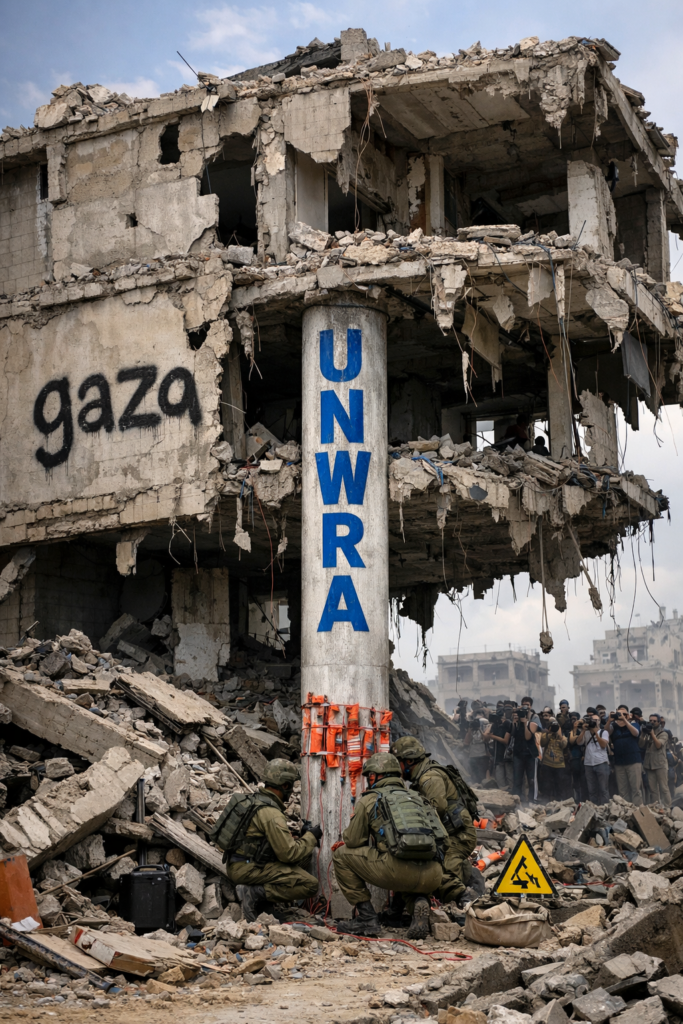
When Philippe Lazzarini announced that he would step down as Commissioner-General of UNRWA, he did not issue the kind of carefully balanced farewell statement that typically accompanies the end of a senior UPhilippe Lazzarini did not use the final days of his tenure as Commissioner-General of the United Nations Relief and Works Agency for Palestine Refugees (UNRWA) to deliver a conventional farewell or a carefully balanced institutional summary of his time in office, but instead chose to articulate a sweeping and deeply unsettling assessment of a global system that, in his view, has not merely failed to protect one of its core humanitarian institutions, but has permitted its systematic dismantling to proceed in full public view and with little meaningful resistance.
After more than two years overseeing what he described as sustained physical, political and legal attacks on UNRWA, particularly across the Gaza Strip and occupied East Jerusalem, Lazzarini leaves behind an organisation that is no longer simply operating under pressure or strain, but is approaching a point at which its continued existence can no longer be assumed, while at the same time warning that the consequences of this potential collapse extend far beyond the immediate suffering of Palestinian refugees and into the structural integrity of the international legal order itself.
His final interventions, most notably a published article in The Guardian on 21 March 2026 and a major address delivered shortly afterwards at the Geneva Graduate Institute, should therefore be understood not as retrospective reflections, but as urgent warnings directed at governments, institutions and political actors who continue to invoke the language of international law while demonstrating, through their actions and inaction alike, that they are either unwilling or unable to enforce those principles when confronted with sustained violations.
“I bow out at a perilous time for international law,” Lazzarini wrote, before adding in the same intervention that “the consequences are not limited to Palestinians alone,” but extend “to the wider Middle East and beyond,” thereby making clear that the stakes involve not only a humanitarian catastrophe but the credibility of the system that claims to regulate conflict itself.
A Seventy-Five Year Institution Brought to the Brink
To fully understand the significance of Lazzarini’s warning, it is necessary to situate UNRWA within its historical and political context, since the agency’s role has never been limited to the provision of humanitarian assistance, but has instead evolved into a complex institutional framework that functions as a surrogate public administration for millions of Palestinian refugees whose displacement dates back to the events surrounding the establishment of the state of Israel in 1948.
Created in 1949 by the United Nations General Assembly as a temporary mechanism intended to provide relief until a political resolution could be achieved, UNRWA has persisted for more than seven decades precisely because that resolution has never materialised, thereby expanding into a system that delivers education, healthcare, food assistance, sanitation services and social protection across Gaza, the West Bank, Jordan, Lebanon and Syria.
Within Gaza, where local governance structures have been repeatedly weakened by cycles of conflict, blockade and infrastructural destruction, UNRWA has effectively functioned as the backbone of civilian life, a reality that makes Lazzarini’s warning particularly stark when he states that the agency is now “approaching the end of its viability” without “immediate and robust political and financial support.”
The scale of the destruction, he argues, cannot be dismissed as incidental, since “what has unfolded is not just the result of war,” but reflects a broader pattern in which the agency itself has come under sustained and multidimensional attack.
By early 2026, more than 390 UNRWA staff had been killed, a figure that Lazzarini repeatedly highlighted as unprecedented, noting in his speech that “within two months of the start of the war, 130 of my colleagues had been killed,” and that he had written at the time predicting that the number would rise, adding with stark understatement that “I knew more would be killed, but not how many.”
The Absence of Consequence
Under normal circumstances, such developments would be expected to trigger a forceful response from the international community, particularly given the legal protections afforded to humanitarian actors and United Nations personnel.
Yet Lazzarini’s central argument is that no such response has materialised.
“It is astonishing that a United Nations agency has been allowed to be crushed in violation of international law, with total impunity,” he stated in Geneva, echoing and intensifying the language used in his earlier written intervention.
This sense of impunity is not presented as an abstract concern, but as an observable reality, reinforced by the continued absence of meaningful consequences despite repeated warnings and documented violations.
“The abject failure to muster an effective response,” he wrote, “enabled a war outside international legal boundaries,” a formulation that shifts the focus from isolated incidents to systemic breakdown.
The Weaponisation of Narrative
In parallel with the physical and legal pressures applied to UNRWA, Lazzarini identifies what he describes as a deliberate and coordinated effort to undermine the agency’s credibility through the dissemination of allegations that, in his words, constitute “malicious assertions… repeatedly debunked.”
These claims, which centre on allegations of neutrality breaches and infiltration by militant actors, have nevertheless been widely circulated and have had tangible effects, including the suspension of funding by donor states.
“They are intended to erode international support for UNRWA,” he explained, adding that this process ultimately serves to “weaken Palestinian rights within final status issues,” thereby linking the information campaign directly to the political dimensions of the conflict.
Gaza as a Turning Point
In his Geneva speech, introduced by Andrew Clapham, Lazzarini situates Gaza within a broader transformation of the international system, stating that “UNRWA has become a bellwether for the changes sweeping across the Middle East and the multilateral system.”
His account of the war combines personal testimony with structural critique, recalling his visit to Gaza in November 2023, when “nothing was entering the strip” and “people lacked everything.”
He described meeting a young girl in a UN shelter who stood before him “begging for a sip of water and a piece of bread,” adding that “the despair in her eyes still haunts me,” a moment that encapsulates the human dimension of the crisis while reinforcing its broader implications.
“The most intense bombardment of a civilian population since World War II followed,” he said, before concluding that Gaza had been transformed into “a post-apocalyptic wasteland.”
He went further still in his characterisation of the humanitarian situation, stating unequivocally that “food was weaponised,” and that famine conditions affecting hundreds of thousands of people constituted “a man-made famine.”
Aid distribution mechanisms, he added, became “nothing else than death traps,” where civilians were killed while attempting to access food, a description that underscores the extent to which the basic principles of humanitarian protection have broken down.
The Systematic Targeting of UNRWA
Lazzarini’s speech reinforces the conclusion that UNRWA itself has been deliberately targeted.
“For decades, Israel has considered the agency a necessary evil,” he explained, before stating that “after October 7, UNRWA became an unnecessary evil,” and that “eliminating UNRWA became an objective of the war.”
He also referenced the narrative used to justify this position, noting that Israeli authorities have advanced the claim that “Hamas is Gaza, Gaza is UNRWA, and UNRWA must therefore be Hamas,” a formulation that he rejects as both unfounded and strategically motivated.
The consequences for staff and infrastructure have been severe, with Lazzarini noting that “many died alongside their children,” while others were “arbitrarily detained and tortured,” and that during the siege “colleagues were fainting from hunger while working in our clinics and shelters.”
A New Phase of Impunity
Perhaps the most striking element of Lazzarini’s final intervention is his assertion that the nature of violations has changed.
“What is new is that these violations are no longer hidden,” he said, adding that “they are claimed, committed with pride,” and even documented in what he described as “war trophy selfies.”
This shift, combined with the absence of accountability, has created what he called “a total sense of impunity,” in which “rules do not apply even if it leads to a new form of barbarism.”
“The fact that these violations have gone unanswered,” he continued, “has further compromised international norms,” a statement that directly links inaction to the erosion of the legal framework itself.
The Collapse of Universality
Lazzarini’s critique extends to the broader perception that international law is no longer applied consistently.
He noted that many now believe that “the values enshrined in international law do not apply equally,” particularly in the context of the Israeli-Palestinian conflict, thereby undermining the universality that gives those norms their legitimacy.
“Our leaders are not fighting back,” he stated bluntly. “They feel intimidated and powerless,” and are “failing in their responsibilities.”
Silence, Complicity and Responsibility
In one of the most direct passages of his speech, Lazzarini invoked Desmond Tutu, reminding his audience that “to be silent in the face of oppression is to choose the side of the oppressor,” before adding his own conclusion that “silence is complicity, so is inaction.”
He emphasised that humanitarian actors have a duty not only to provide assistance but also to speak out, stating that “to be vocal is a choice, and in my view to be vocal is a duty,” even when doing so carries professional or personal risk.
A System at Risk
The broader significance of Lazzarini’s warning lies in what it reveals about the current state of the international system, which he suggests is undergoing a fundamental transformation.
“We are living in dangerous and unpredictable times,” he said, warning that the erosion of international law is contributing to a wider breakdown in the rules that have governed global conduct since the end of the Second World War.
A Warning on Record
Lazzarini’s final appeal is framed in terms of urgency.
“We must act not belatedly but now,” he urged, calling for “a broad coalition genuinely committed to uphold international law.”
Whether this call will be answered remains uncertain, but its significance lies in the clarity and directness with which it has been articulated.
By the end of his tenure, Philippe Lazzarini has ensured that the consequences of what is unfolding have been placed on record in unmistakable terms, leaving little room to claim that the erosion of international law, the dismantling of a United Nations agency, and the suffering of millions occurred without warning.