


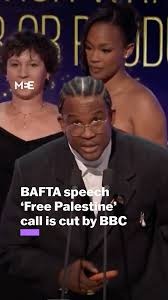
The BBC is facing one of the most pointed editorial controversies of the year after removing the words “free Palestine” from its televised broadcast of the British Academy Film Awards — despite the programme airing approximately two hours after the live ceremony, allowing full editorial review before transmission.
The phrase was spoken clearly and deliberately on stage by British-Nigerian filmmaker Akinola Davies Jr. as he accepted the Outstanding Debut award for his film My Father’s Shadow at London’s Royal Festival Hall.
In full, Davies Jr. said:
“And lastly, to all those whose parents migrated to obtain a better life for their children. To the economic migrant, the conflict migrant, those under occupation, dictatorship, persecution, and those experiencing genocide. You matter. Your stories matter more than ever. Your dreams are an act of resistance. To those watching at home, archive your loved ones. Archive your stories yesterday, today, and forever. For Nigeria, for London, the Congo, Sudan — free Palestine. Thank you.”
Those inside the hall heard the line clearly. Audience recordings show sections of the crowd responding with audible cheers and applause as he finished.
Viewers watching the BBC broadcast at home did not hear the final two words.
The phrase “free Palestine” had been removed.
Not Live — Edited
The BAFTAs ceremony was not transmitted live. The BBC broadcast went out roughly two hours after the event concluded. That delay is central to the controversy.
This was not a split-second live bleep. It was not a reactive scramble in a control room during real-time transmission. The two-hour window meant the programme was reviewed, edited and curated before reaching millions of viewers.
The removal therefore appears to have been a deliberate editorial decision.
The BBC has not publicly identified who authorised the cut.
What Was Left In
The controversy has intensified because of what the broadcaster did not remove.
During the same ceremony, while actors Michael B. Jordan and Delroy Lindo were presenting an award, a man in the audience shouted the N-word.
The slur was audible in the BBC broadcast.
The individual was later identified as John Davidson, a Tourette’s campaigner whose condition can cause involuntary verbal tics, including socially taboo language. He is the subject of a biopic titled I Swear, which was recognised at the ceremony.
Host Alan Cumming addressed the incident on stage, apologising “if you were offended” and explaining that the outburst was linked to Tourette’s syndrome.
The BBC later said its failure to edit out the slur was due to production constraints and the programme being handled from a broadcast truck. Critics have questioned that explanation given the two-hour delay.
The editorial contrast is what has fuelled outrage:
A racial slur remained audible.
A political statement — “free Palestine” — was cut.
The Words The BBC Removed
Davies Jr.’s speech was not a casual aside. It was part of a broader reflection on migration, occupation and genocide. The concluding line followed references to “those under occupation, dictatorship, persecution, and those experiencing genocide.”
When he said “free Palestine,” applause followed.
The BBC broadcast ended his speech before that phrase.
For supporters of the edit, award ceremonies are entertainment programmes, not political platforms.
For critics, the removal appears selective and politically sensitive — particularly given the scale of public mobilisation in the UK over Gaza.
Millions on the Streets
Since the escalation of war in Gaza, Britain has witnessed some of the largest demonstrations in modern history. Marches in London have drawn hundreds of thousands of people at a time, with cumulative participation reaching into the millions across the country over three years of sustained protest.
Those marches have consistently called for:
• A ceasefire
• An end to UK arms sales to Israel
• An end to what protesters describe as British institutional complicity
Many of those demonstrators are BBC licence fee payers.
Against that backdrop, critics argue that removing “free Palestine” from a pre-recorded broadcast appears out of step with a significant segment of the British public.
Internal BBC Dissent
The BAFTAs edit does not stand in isolation. It lands amid ongoing internal unrest within the BBC over its Gaza coverage.
More than 100 BBC journalists and staff members reportedly signed a letter to Director-General Tim Davie raising concerns about what they described as imbalanced reporting and excessive caution when covering Israel’s military actions in Gaza.
Separate open letters signed by hundreds of media professionals have criticised programming decisions and alleged that the broadcaster is overly concerned with being perceived as critical of Israel.
Questions have also been raised publicly about the role of Robbie Gibb, a BBC board member and part of the Editorial Standards Committee, with critics arguing that perceived conflicts of interest damage trust. The BBC has rejected claims of improper influence and maintains that its governance structures ensure impartiality.
Licence Fee Pressure
The controversy also unfolds during heightened debate about the future of the BBC licence fee.
Social media campaigns encouraging viewers to boycott BBC News or refuse payment have gained traction amid wider dissatisfaction with coverage of Gaza.
While no official figures directly link licence fee trends to this specific controversy, the broadcaster is operating in an atmosphere of intensified scrutiny from both left and right.
From one side, it faces accusations of being too critical of Israel.
From another, it faces accusations of downplaying or sanitising Israel’s military campaign.
The BAFTAs edit has fed directly into that tension.
Where Is the Broadcast?
Compounding the accountability question is the fact that the BAFTAs broadcast is not currently available on BBC iPlayer for public review.
That absence makes it difficult for viewers to independently check the closing credits to identify:
• The programme editor
• The executive producer
• The compliance editor
• The senior editorial lead
The BBC has not publicly named the individual or individuals responsible for authorising the removal of “free Palestine.”
A Question of Editorial Standards
Broadcasters routinely trim acceptance speeches for time.
They also routinely remove profanity.
But “free Palestine” is neither profanity nor hate speech under UK law. It is a political slogan — widely used at protests, in Parliament debates and across mainstream civil society.
The decision to remove it — in a programme broadcast two hours after the event — was therefore not a technical necessity. It was an editorial judgment.
Critics argue that the juxtaposition with the unedited racial slur makes the judgment appear inconsistent.
Supporters argue that managing political messaging during entertainment broadcasts is part of maintaining impartiality.
The Central Fact
One fact remains uncontested:
Akinola Davies Jr. said “free Palestine” on stage at the BAFTAs.
The audience heard it.
The broadcast audience did not.
With millions of Britons having marched in support of Palestinian civilians over the past three years — and with internal BBC staff raising concerns about Gaza coverage — the edit has become more than a footnote in an awards show.
It has become a symbol in a broader argument about editorial transparency, political sensitivity and the responsibilities of a national broadcaster in a time of war.
Until the BBC explains who authorised the cut and under what policy, the question will remain:
Why were those two words removed — and who decided they should not be heard?