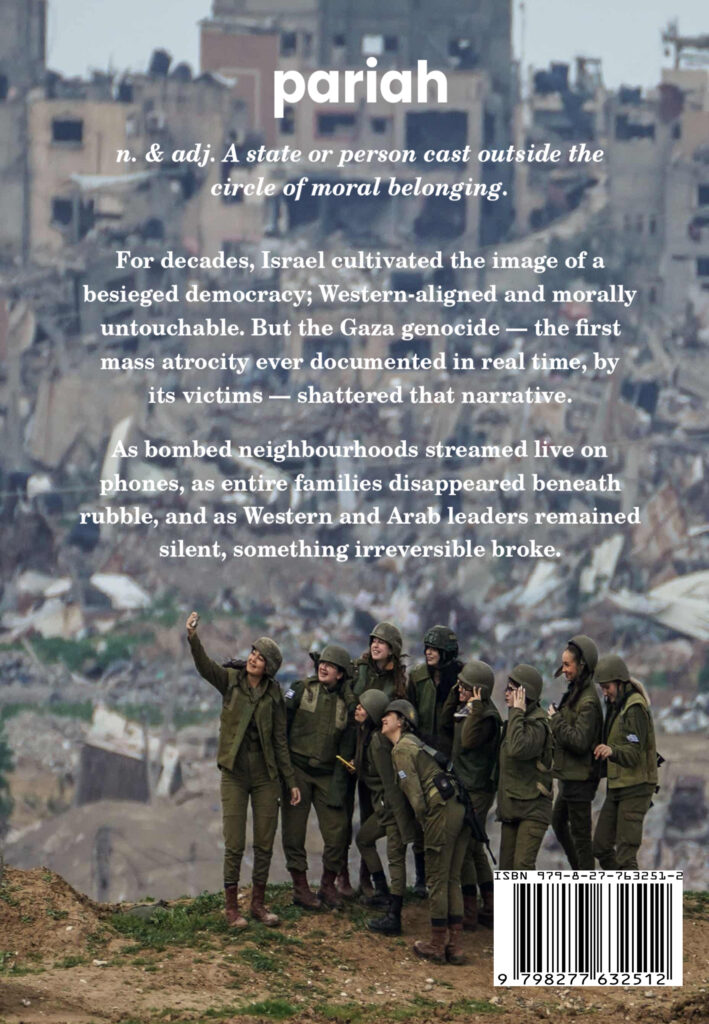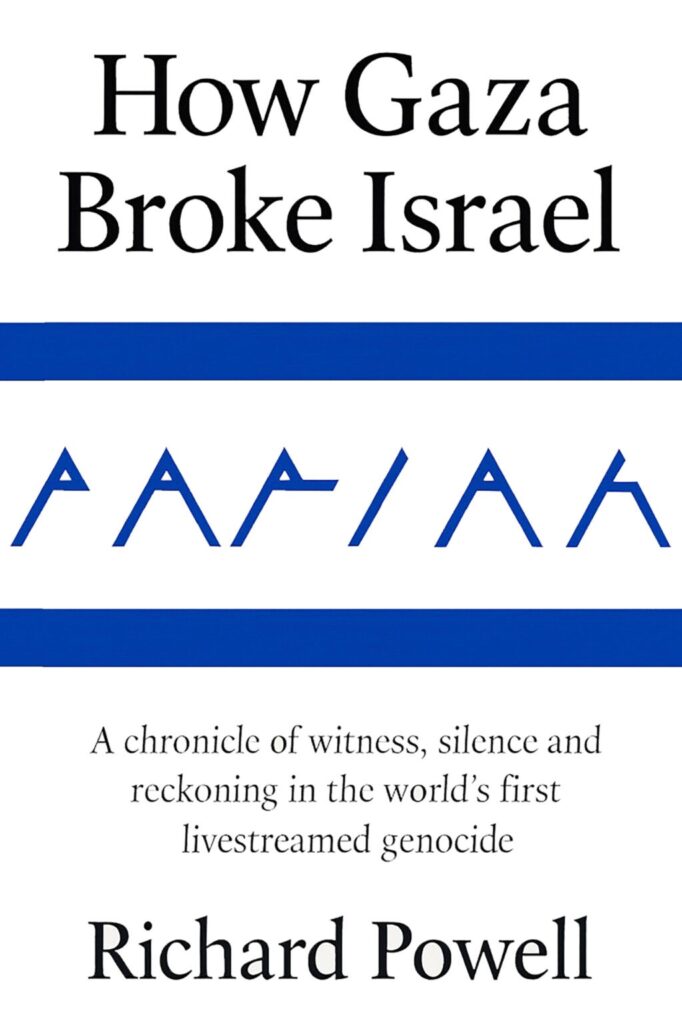
Wars often reveal more than they destroy. Some expose the limits of military power. Others reveal the fragility of political narratives that had long gone unchallenged. Richard Powell’s definitive Pariah: How Gaza Broke Israel belongs to the latter category. It is not simply a book about the Gaza war or even about the enduring conflict between Israel and Palestine. It is a sustained examination of how Western moral authority falters when tested under conditions of uninterrupted global visibility.
Powell’s central argument unfolds gradually rather than theatrically. He suggests that Gaza forced a confrontation between declared universal principles and observable state behaviour. For decades, Western governments have framed themselves as custodians of a rules-based international order grounded in international humanitarian law. Civilian protection, proportionality, accountability and the rule of law have been articulated as global standards rather than regional preferences. In Gaza, those standards were not abandoned in rhetoric. They were invoked. The question Powell raises is whether they were applied with consistency.
The book resists the temptation to begin with the dramatic events of October 2023. Instead, it turns first to structure. Powell reconstructs the administrative and political architecture that shaped Gaza long before escalation. Border closures, restrictions on imports and exports, limits on movement and an entrenched logic of demographic containment created conditions of sustained vulnerability. Electricity systems were fragile, medical infrastructure was under strain and economic development was tightly constrained. These were not incidental features, they formed the backdrop against which the war unfolded.
“The definitive historical record of the Gaza war and the failure of the Western world.”
By establishing this prehistory, Powell complicates any interpretation that treats the devastation of Gaza as an isolated response to a singular event. If conditions of life were already systematically restricted, then the scale of destruction that followed cannot be understood without reference to those prior policies. For readers concerned with international law and the evolving ICJ genocide case involving Israel, this structural framing is significant. Legal interpretation does not operate in a vacuum; it weighs intent, pattern and the cumulative effect of policy choices.
The idea of Western hypocrisy in Gaza has circulated widely in political discourse, sometimes as slogan and sometimes as accusation. Powell attempts to approach it analytically rather than emotionally. He compares the rapid and forceful invocation of international law in other conflicts, particularly in Ukraine, with the more cautious language adopted during the Gaza war. In Ukraine, violations of sovereignty were framed as existential threats to the global order. War crimes investigations were endorsed immediately. Sanctions were imposed with speed and clarity.
In Gaza, expressions of Israel’s right to self-defence were immediate and emphatic. Appeals to proportionality and restraint appeared later and often in more qualified terms. Military assistance continued even as images of widespread civilian devastation circulated globally. For many observers across Africa, Latin America and parts of Asia, the discrepancy did not appear subtle, it suggested that universal standards might function selectively.
Powell does not argue that states should abandon alliances. He argues that alliances complicate claims of universalism. Legitimacy, in his view, depends less on moral perfection than on demonstrable consistency. When rules appear to bend according to strategic alignment, credibility diminishes.
The unprecedented visibility of the Gaza war intensified this dynamic. In earlier conflicts, narrative control benefited from time. Official briefings shaped early perceptions, and investigative reporting followed gradually. In Gaza, the informational sequence was inverted. Civilian footage from residential neighbourhoods, hospital corridors and refugee camps circulated almost immediately. Satellite imagery confirmed damage patterns within hours. Independent analysts used open-source intelligence techniques to verify strike locations in real time.
This collapse of narrative delay altered the environment in which governments operated. When officials described precision operations, audiences compared those statements instantly with visual evidence of flattened apartment blocks. When casualty figures were questioned, images from overwhelmed medical facilities circulated concurrently. The gap between rhetoric and observation narrowed in ways that previous generations of policymakers had rarely encountered.
The proceedings initiated at the International Court of Justice further complicated diplomatic positioning. When South Africa filed its genocide case against Israel, the conflict entered formal judicial territory. Powell examines the legal thresholds embedded in the Genocide Convention, including the requirement to establish intent and the destruction of conditions necessary for life. He does not presume the outcome of those proceedings. Instead, he highlights their symbolic and procedural weight. Once allegations are lodged within an international court, they move beyond activist discourse into institutional scrutiny.
For those conducting serious ICJ genocide case Israel analysis, Powell’s contribution lies not in definitive legal judgment but in contextual layering. The court does not assess isolated incidents alone. It evaluates patterns, language and cumulative impact. In this sense, the structural prehistory of Gaza becomes legally relevant.
Casualty counting, often reduced to a battle over numbers, receives careful treatment in the book. Powell interrogates the distinction between direct deaths from bombardment and indirect mortality resulting from infrastructure collapse, disease and deprivation. Narrow registries, he argues, may understate the broader human toll in siege conditions. At the same time, expansive estimates invite methodological scrutiny. The point is not to inflate figures for rhetorical effect but to acknowledge that statistical frameworks shape collective memory. Gaza civilian casualties accountability cannot be meaningfully discussed without clarity about how loss is measured.
The political consequences of the war unfolded unevenly across the Western world. In the United States, congressional votes approving continued military assistance underscored the durability of alliance commitments. Yet campus protests, generational polling shifts and visible fractures within political parties indicated growing discomfort. Europe experienced similar tensions. Governments attempted to balance strategic alignment with humanitarian concern. Parliamentary dissent and public demonstrations revealed fault lines that had previously been less visible.
Across the Global South, diplomatic language often emphasised accountability more directly. Historical experiences with colonialism and intervention shaped the tone of official statements. The perception that international law is enforced selectively reinforced scepticism about the credibility of the rules-based international order.
“The digital archive of Gaza is unlikely to disappear. Images, satellite data and legal filings will remain accessible. Future debates about Israel, Palestine and international law will unfold against this documented record.”
Powell does not portray emerging powers as paragons of consistency. He is attentive to geopolitical opportunism. His argument instead concerns Western self-conception. When states claim normative leadership, deviation carries symbolic cost beyond immediate strategy.
The economic dimension of the conflict appears in the book not as conspiracy but as context. Defence contracts, energy infrastructure in the Eastern Mediterranean and complex lobbying networks form part of the strategic landscape. These factors remind readers that foreign policy rarely unfolds in a vacuum of pure moral reasoning. Yet Powell insists that economic entanglement does not dissolve normative obligation. If anything, it heightens the difficulty of maintaining consistency.
Perhaps the most enduring theme of Pariah concerns generational memory. Younger audiences consumed the Gaza war through digital platforms rather than traditional broadcast media. Their understanding of the conflict formed in parallel with livestreamed evidence. Trust in institutional narratives competed directly with open-source documentation. In this environment, legitimacy cannot be secured through messaging alone. It must withstand immediate comparison with visible reality.
The digital archive of Gaza is unlikely to disappear. Images, satellite data and legal filings will remain accessible. Future debates about Israel, Palestine and international law will unfold against this documented record. Powell suggests that the war may mark a turning point in how political consciousness forms in Western societies.
It is possible to disagree with aspects of Powell’s interpretation. Critics may argue that the book gives insufficient weight to Israeli security concerns or compresses certain complexities. Yet the core question it raises cannot be easily dismissed. When universal standards are invoked repeatedly in global politics, what happens when their application appears inconsistent?
Gaza did not invent accusations of Western hypocrisy. It illuminated them under conditions of relentless visibility. Whether this illumination leads to institutional reform, deeper cynicism or geopolitical fragmentation remains uncertain. What is clear is that the informational environment has changed. Contradiction now travels as quickly as rhetoric.
Pariah: How Gaza Broke Israel is available in ebook, paperback and hardback editions. Full retailer information, including Amazon listings, is available at https://pariahbook.com/, where readers can also download the first three chapters free of charge.
Rating: ★★★★★
Final Verdict: The definitive historical record of the Gaza war and the failure of the Western world.