


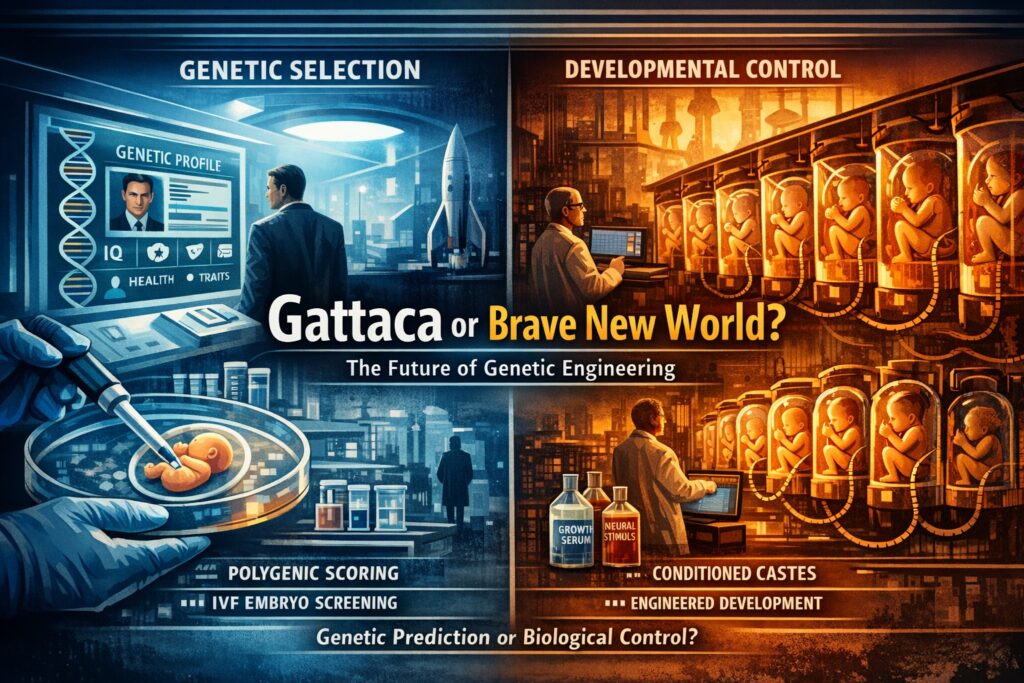
When Gattaca premiered in 1997, it felt chilling precisely because it was so restrained. No flying cars. No mutants. Just babies quietly graded at birth, careers quietly closed off, and a society that insisted it was only following “the science.”
Six decades earlier, Brave New World had imagined something far more baroque: embryos bottled and batch-produced, humans chemically nudged into castes, inequality engineered not through prediction but through controlled development itself.
For years, Gattaca was treated as the more plausible warning — a future of genetic sorting rather than genetic manufacturing. But as gene-editing technologies advance, artificial intelligence digests human genomes, and embryo screening moves from clinic to consumer conversation, an uncomfortable question is resurfacing:
If biology really does shape destiny, which dystopia were we actually heading toward?
And more importantly: are we anywhere near either of them?
The core promise — and illusion — of Gattaca
At the heart of Gattaca is a seductive idea: that with enough genetic information, human potential becomes legible, predictable, and sortable. Your genome becomes your résumé. A blood drop on a keyboard quietly decides your future.
Technologically, this vision rests on two assumptions. First, that complex traits can be predicted reliably from DNA. Second, that society would trust those predictions enough to institutionalise them.
Today, the first assumption is only partially true — and the second remains constrained by the first.
Modern genetics has made real progress in polygenic risk scoring: statistical models that aggregate the tiny effects of thousands of genetic variants to estimate risk for diseases such as heart disease, diabetes, or myopia. These tools are improving, especially with the help of machine learning and ever-larger genomic datasets.
But here is the central limitation. Polygenic scores predict risk, not destiny.
Even for traits with strong genetic components, outcomes remain probabilistic and heavily shaped by environment — nutrition, stress, education, illness, social context, and sheer chance. A genome can tilt the odds; it cannot write the script.
In other words, the science that would make Gattaca’s genetic determinism work at scale still does not exist — and may never fully exist.
The engineering problem Gattaca avoids
What Gattaca largely sidesteps is a deeper biological reality: editing or selecting genes is not the same as controlling development.
Most traits people care about — intelligence, temperament, resilience, creativity — are not “stored” in DNA like files on a hard drive. They emerge through a long and fragile developmental process involving gene regulation, hormonal timing, neural wiring, metabolism, and environmental input.
Even if scientists could identify every gene involved — which they cannot — editing thousands of genetic loci reliably would be an engineering nightmare. Errors compound. Trade-offs appear. Small gains in one domain often come with hidden costs in another.
This is where Brave New World, oddly, looks more biologically honest.
Brave New World’s uncomfortable realism
Aldous Huxley grasped something modern genetics continues to rediscover: you do not engineer outcomes by tweaking blueprints alone — you engineer them by controlling the build process.
In Brave New World, embryos are not perfected by elegant genetic edits. They are gestated in tightly controlled environments, exposed to chemical gradients, and developmentally nudged toward predefined roles. Inequality is not primarily genetic in the narrow sense; it is developmental.
From a purely technical standpoint, this approach aligns more closely with how biology actually works.
Genes set ranges. Development determines where individuals land within them.
If humanity were ever to cross the threshold into genuine biological stratification, it would almost certainly rely less on precise gene editing and more on developmental modulation: endocrine control, epigenetic programming, environmental standardisation, and timing.
That future is not here. But it is also not blocked by the same hard limits that plague large-scale multi-gene DNA editing.
What gene editing can actually do today
Strip away the hype and current capabilities are narrow but real.
Modern gene-editing tools such as CRISPR can disable or repair single genes, treat certain monogenic diseases, and edit human cells outside the body with growing reliability. These interventions are powerful for rare conditions where one broken gene causes catastrophic harm.
They cannot reliably edit thousands of genes at once. They cannot engineer complex traits. They cannot eliminate broad conditions like myopia, intelligence variance, or personality differences.
The one confirmed case of human embryo gene editing, revealed in China in 2018, demonstrated feasibility rather than mastery. The edits were crude, uneven, and biologically risky. It proved the door was unlocked, not that anyone knew how to walk through it safely.
If Gattaca assumes genetic precision, reality remains blunt-force.
The real trajectory: selection, not design
Where Gattaca may yet find relevance is not in genetic engineering, but in genetic selection.
With IVF, multiple embryos already exist. Screening them for serious inherited disease is now routine. Screening them for statistical advantages — lower disease risk, slightly higher predicted traits — is technologically straightforward, even if the gains remain modest.
This is not a world of guaranteed superiority. It is a world of incremental advantage, amplified over time by wealth, education, healthcare, and opportunity.
A few percentage points here. A slightly healthier baseline there.
Biology does not create the caste system. Society does the compounding.
That is where Gattaca’s real warning lies: not in perfect prediction, but in trusted approximation.
Artificial intelligence changes the scale, not the ceiling
Artificial intelligence does change the landscape — but not in the way science fiction often implies.
AI excels at pattern recognition, risk stratification, and optimisation within known constraints. It will almost certainly improve genetic prediction models and integrate genomic data with medical histories, developmental metrics, and behavioural signals.
What it will not do is collapse uncertainty.
Biology remains noisy. Development remains contingent. AI sharpens probabilities; it does not abolish variance.
The danger is not AI creating certainty, but institutions behaving as though probability were destiny.
Epigenetics: the quiet wildcard
If there is a genuine wildcard in this story, it is epigenetics — the layer of biological regulation that determines which genes are switched on, when, and where.
Unlike DNA sequence, epigenetic states are modifiable, responsive to environment, and potentially adjustable without rewriting the genome. In theory, epigenetic tools could allow targeted modulation of growth, metabolism, or neural development without permanent genetic alteration.
In practice, this remains early-stage science. Delivery, stability, and unintended effects remain formidable challenges.
But epigenetics points toward a future that looks less like Gattaca’s clean genetic sorting and more like Brave New World’s developmental nudging.
Why convergence may win over divergence
For all the dystopian anxiety, powerful countervailing forces push in the opposite direction.
Most human outcomes are still shaped far more by early childhood conditions, nutrition, infection exposure, education quality, and social stability than by marginal genetic differences. Cheap, scalable interventions often outperform expensive biological ones.
Outdoor time reduces childhood myopia more effectively than any conceivable gene edit. Vaccination, sanitation, and education flatten inequality faster than embryo selection ever could.
Even genetically “optimised” populations would regress toward the mean through recombination and environmental variability unless subjected to extreme, sustained control.
Biology resists permanent stratification.
So which future are we actually heading toward?
Not Gattaca. Not Brave New World. And not nothing.
What lies ahead looks more like a soft genetic age: better prediction, limited selection, no guaranteed outcomes, and persistent uncertainty.
A world where biology informs opportunity without fully dictating it.
The real danger is not designer babies. It is overconfidence — mistaking probability for fate, correlation for cause, and data for destiny.
Science fiction warned us about genetic tyranny. Reality may deliver something quieter: a world where imperfect predictions quietly shape lives, not because they are right, but because they are trusted.
And history suggests that when societies place too much faith in flawed measurements, it is never biology that does the real damage.
In the end, the most important question is not whether we will get Gattaca or Brave New World.
It is whether we remember that humans are more than the sum of their markers — genetic or otherwise.