


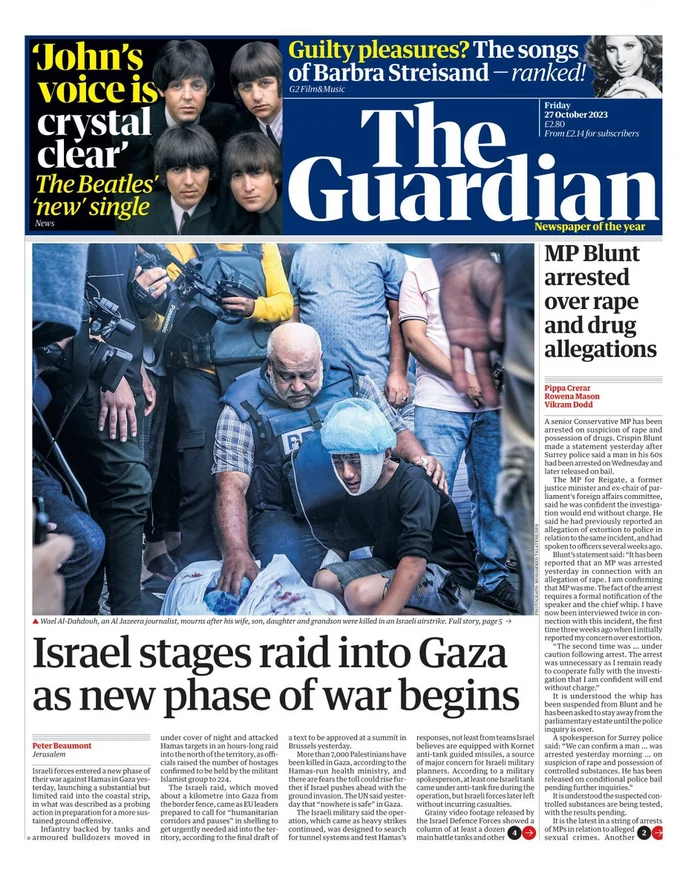
As Gaza’s civilian death toll soared and Israel launched its most destructive military campaign in decades, the Guardian quietly sat down with a top Israeli general. The meeting remained secret until exposed by foreign documents — and the Guardian still won’t explain why.
The Paper That Claims It “Cannot Be Bought”
When the Guardian appeals to readers to support its journalism, the message is always the same: We’re different. We’re independent. We can’t be bought.
The paper reminds readers of the Scott Trust — created in 1936 when John Scott renounced his inheritance to safeguard the Guardian’s “editorial independence in perpetuity.” It boasts of being immune to billionaires, hedge funds, political parties or states. It asks readers to donate monthly because its journalism is supposedly answerable only to its own conscience.
Few newspapers sell their integrity harder.
But behind this immaculate branding, something else happened — something that cuts straight through the Guardian’s public claims of incorruptibility.
In early November 2023, during the opening weeks of Israel’s assault on Gaza — at a time when international law experts were warning of war crimes, civilian casualties were soaring, and Gaza’s infrastructure was collapsing — the Guardian’s editor-in-chief, Katharine Viner, met privately in London with former IDF chief of staff Aviv Kohavi.
No reader was told this meeting occurred. No statement appeared in the Guardian’s pages. No transparency note. No editorial note. No disclosure. It was not mentioned in coverage of Israel, Gaza, or media influence operations.
The only reason the public knows the meeting happened at all is because it appeared in documents released by the Israeli Ministry of Foreign Affairs following a freedom-of-information request — not from the Guardian, but from Israel itself.
And now, more than a year and a half later, the Guardian still refuses to say what happened in that meeting.
Israel’s Influence Tour — and the Guardian’s Role in It
The meeting was part of a coordinated Israeli initiative. According to the documents released via FOI, Kohavi travelled to London as part of an information campaign designed to “influence various target audiences” in Western media during the Gaza war.
These were not casual diplomatic niceties. They were strategic, tightly planned engagements between Israeli officials and the most powerful newsrooms in Britain: the BBC, Sky News, the Financial Times — and the Guardian.
An Israeli Ministry of Defence adviser described the purpose clearly:
“Visits by high-ranking Israeli dignitaries to Western countries will help influence various target audiences… we see these meetings as highly important in dealing with individuals who have significant impact on the legitimacy of the State of Israel.”
Among those individuals was The Guardian’s Editor, Katharine Viner.
This was one month into Israel’s bombardment of Gaza. Over 10,000 Palestinians, including thousands of children, were already dead. The UN was warning of mass starvation. Human rights groups were sounding alarms about ethnic cleansing. In Europe, pro-Palestinian protests were exploding.
At such a moment, a private meeting between the paper’s editor and a former Israeli chief of staff — a man central to shaping the very military now levelling Gaza — should have been disclosed to readers as a matter of basic journalistic transparency.
Instead, the opposite occurred: silence.
The Guardian’s Explanation? One Sentence. Quietly. To Someone Else.
When Declassified UK exposed the meeting in 2024, the Guardian’s public comment did not appear on its own website. It did not appear as a correction or disclosure. It was not mentioned in its Gaza coverage.
Instead, one spokesperson offered one line to another newspaper:
The meeting was “not an endorsement, but part of responsible journalism.”
Nothing more. No details. No context. No record. No list of participants. No explanation of editorial safeguards. No description of what Kohavi said, what he asked for, what the Guardian asked him, or whether any materials were provided.
For a paper that preaches transparency, this level of opacity is staggering.
Consider: if the Guardian’s editor had met privately with Hamas officials during the same period, would the meeting have been omitted entirely from public view?
Or would it have appeared in bold headlines?
Inside the Newsroom: “Deceit by Omission” and a “Mountain of Examples”
This meeting did not happen in a vacuum. Several Guardian journalists have since described internal discomfort over coverage of Gaza — and say the editorial line has often aligned with establishment narratives, not independent reporting.
One journalist spoke of an “exhaustive spreadsheet” compiled by staff documenting dozens of examples of skewed, incomplete, or misleading Gaza coverage, including:
- Amplifying unchallenged Israeli claims
- Using language that delegitimised Palestinian reports, especially casualty figures
- Downplaying statements from Israeli officials that showed apparent genocidal intent
- Omitting international law implications from stories that clearly demanded them
- Using passive voice for Palestinian deaths while explicitly naming Hamas as perpetrators of Israeli deaths
- Treating Israeli military “evacuation orders” as humanitarian acts rather than potential war crimes
The journalist described the Guardian’s approach as “deceit by omission.”
They added that editors often responded defensively when concerns were raised.
The mood inside the newsroom raises a critical question: Did the Kohavi meeting further reinforce an already skewed editorial culture?
We don’t know, because the Guardian refuses to say.
Data Analysis: Israel’s Story Elevated, Palestine’s Minimized
Multiple independent studies show consistent patterns in the Guardian’s Gaza output:
1. Emotional Language Favoured Israeli Victims
In headline analysis:
- Israeli victims received nearly twice as much emotive language as Palestinian victims, despite Palestinians suffering vastly higher casualties.
2. Israeli Hostages Dominated Coverage
The Guardian ran:
- 47 headlines about Israeli hostages
- Just 7 about Palestinian prisoners — despite thousands of Palestinians held without trial and thousands more detained during the war.
3. Responsibility for Palestinian Deaths Was Rarely Attributed
In Guardian headlines:
- Israel was directly named as the perpetrator in a minority of Palestinian death reports.
- Hamas was directly named in the majority of Israeli death reports.
This asymmetry reinforces a worldview where Israeli suffering has actors — Palestinians simply “die.”
Past Patterns: A Longstanding Sensitivity on Israel-Palestine
The Kohavi meeting also fits a longer pattern inside the Guardian.
Over the past decade:
- Former contributors like Nafeez Ahmed reported that Israel-related stories were “tightly controlled” by senior editors.
- Several journalists have spoken of pieces being spiked or softened for political rather than journalistic reasons.
- Some staff say the Guardian faces — and responds to — intense pressure from the UK’s pro-Israel lobby, particularly the Board of Deputies.
- Since October 2023, insiders say all opinion pieces on Israel-Palestine required direct approval by Viner herself.
The Guardian denies censorship.
But the meeting with Kohavi, held in secret, undeniably deepens suspicion.
The Guardian’s Brand vs. Its Behaviour
The newspaper’s public message is polished and righteous:
- “We are independent.”
- “We cannot be bought.”
- “We challenge power without fear.”
- “Our independence is guaranteed in perpetuity.”
But independence is not only about who owns a newspaper.
It is also about:
- who gets access,
- who gets courted,
- who gets briefed,
- who gets heard behind closed doors,
- and who gets to shape the editorial atmosphere.
The Guardian cannot be bought.
But can it be swayed?
Influenced?
Managed?
Pressured?
Cultivated?
That is the real question raised by the Kohavi meeting.
And until the Guardian discloses what happened in that room, readers cannot know the answer.
The Stakes: Gaza, Genocide, and Journalism
This is not a minor ethical footnote. Kohavi’s meeting occurred during:
- the highest civilian death rate of any conflict of the 21st century
- allegations of mass starvation and indiscriminate bombing
- the beginning of an ongoing genocide case at the International Court of Justice
- the near-total destruction of Gaza’s infrastructure
- the collapse of journalism in Gaza due to the killing of local reporters
At such a time, a newspaper famed for its moral stance had a duty to be transparent — especially about interactions with one of the architects of the war.
Instead, it chose silence.
What the Guardian Owes Its Readers
The Guardian now faces a simple test.
If it truly believes in its own slogans — independence, transparency, courage — then it must disclose:
- Who requested the meeting
- Who attended
- What materials were provided
- What was said
- What was asked
- Whether any editorial policies or perspectives were subsequently influenced
Until it does, its appeals for reader funding will ring hollow.
Because editorial independence is not inherited.
It is not guaranteed by a trust document.
It is not maintained by slogans.
Editorial independence is proven — or disproven — by what a newspaper does when nobody is watching.
The Guardian was not being watched when it met Aviv Kohavi.
Now it is.
And until it tells the truth about that meeting, its claim that it “cannot be bought” will remain not a principle — but a marketing line.