


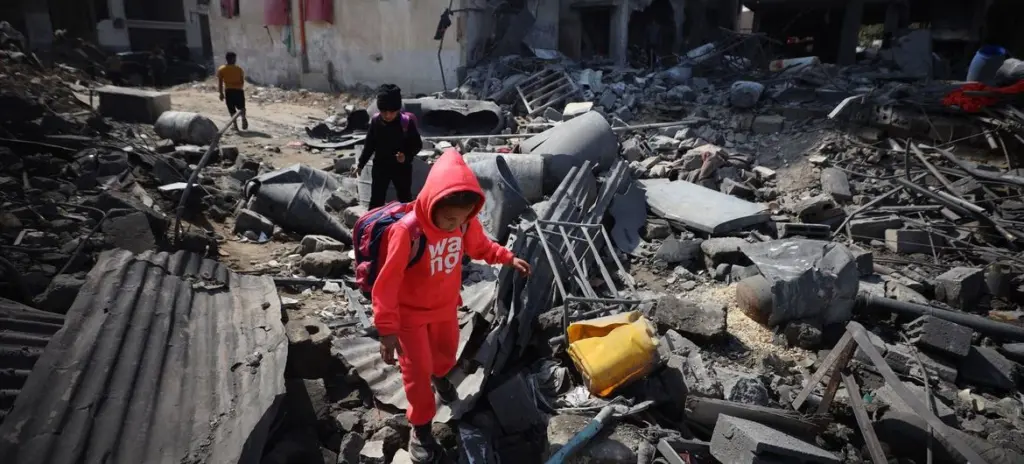
Despite 42 days of what the world calls peace, Israel has killed 279 Palestinians, demolished 1,500 buildings, expanded territorial control by 33 square kilometers, and returned mutilated bodies showing signs of systematic sexual violence
On day 42 of what President Donald Trump calls a “ceasefire” in Gaza, Israeli airstrikes killed 32 Palestinians on Wednesday, including 12 children. The attacks targeted displaced families sleeping in tents in the Zeitoun and Shuja’a neighborhoods of Gaza City. In the aftermath, Gaza Civil Defense spokesperson Mahmoud Basal held up the body of a small girl at Al-Shifa Hospital.
“When will these scenes end in Gaza?” he asked cameras. “When will the scenes of our children being murdered end? They were preparing to sleep in their mother’s embrace, but they were killed. Israel killed them.”
Since the October 10 agreement that Trump and Israeli officials have repeatedly described as ending the war, Israel has committed 393 documented violations, according to the Gaza government media office. The violations have resulted in 279 Palestinian deaths and 652 injuries—a rate of nearly seven Palestinians killed every day of the supposed peace.
But the violence visible in Gaza’s streets represents only one dimension of what Palestinians are experiencing under this “ceasefire.” Electronic Intifada’s analysis of recent reports, satellite imagery, legal documents, and firsthand testimony reveals a coordinated campaign of territorial expansion, systematic sexual torture, humanitarian starvation, and the physical erasure of entire neighborhoods—all occurring under the banner of peace.
The Expanding Occupation: Israel’s Land Grab Under Ceasefire Cover
BBC satellite analysis published this week reveals that Israel has demolished more than 1,500 buildings on the eastern side of Gaza’s so-called “yellow line” since the ceasefire began—adding to what the UN estimates is already 60 million tons of rubble, enough to fill 13 Great Pyramids of Giza.
The yellow line, supposedly a temporary boundary delineating Israeli military control from areas where Palestinians could return, was never intended to be static. But Israel is not only demolishing within its designated zone—it’s expanding it.
According to an investigation by Gaza Municipality engineer and Al Arabi TV correspondent Asem al-Nafi, Israel now controls 62% of Gaza’s territory, 9% more than stipulated in the ceasefire agreement. Hamas stated this week that Israel has exceeded the yellow line by approximately 33 square kilometers, with fire control zones extending 400 to 1,000 meters inside the agreed boundary and concrete blocks placed 2 to 800 meters beyond the line.
Before-and-after satellite images from October 8 (just before the ceasefire) and November 8 show entire neighborhoods leveled. In eastern Rafah, once-rural areas have been completely erased. In Shuja’a, one of Gaza City’s largest neighborhoods with a pre-war population of over 100,000, buildings stretch in ruins as far as cameras can see.
“The BBC says the new photos showed the entire neighborhoods controlled by the Israeli Defense Forces have been leveled in less than a month,” Electronic Intifada reported. “The actual number of destroyed buildings could be significantly higher with satellite imagery for some areas being unavailable for BBC’s assessment.”
Trump’s 20-point peace plan explicitly stated that “all military operations will be suspended.” IDF Chief of Staff Herzi Halevi, during a visit to Rafah on Sunday, made clear Israel’s actual intentions: “We must be prepared for rapid transition to a broad offensive and to seize territory in the Gaza Strip on the other side of the yellow line.”
The demolitions serve multiple purposes. In some cases, Israel is destroying sites where it suffered tactical defeats during the war. One recent IDF press release bragged: “11 months since the three soldiers from the 92nd battalion fell, the tunnel route in which they fell has been dismantled.” Israeli forces are now conducting what they call “snake hunting” operations—raiding weapons caches and tunnels in depopulated areas, then celebrating the capture of what amounts to equipment for a single fighter squad: a few RPG rounds, one sniper rifle, some explosives.
“They make it sound like an impressive military operation,” notes Electronic Intifada’s resistance analyst John Elmer. “But it can only exist because the Palestinians have adhered to the ceasefire and Israel is now doing its courageous missions in depopulated areas.”
The systematic destruction extends beyond military targets. Hamas stated: “The occupation continues on a daily basis to demolish homes located inside areas of control outside the yellow line…in clear explicit breach of the ceasefire agreement. These violations have continued for a full month without stopping, leading to widespread destruction of citizens’ property.”
The violations include:
- 113 direct shooting incidents targeting civilians, homes, and displaced persons’ tents
- 17 incursions by occupation vehicles into residential and agricultural areas
- 174 shelling and bombardment operations by land, air, and artillery
- 85 demolitions of homes and civilian infrastructure
Euro-Med Human Rights Monitor warned that these actions are “not isolated incidents, but part of a systematic pattern, indicating a clear policy by the Israeli political and military leadership to use the ceasefire as a cover to continue genocide against Gaza’s residents.”
Bodies Returned: The Torture Hidden in Plain Sight
While Israel demolishes neighborhoods and expands territorial control, another horror unfolds at Gaza’s crossings: the return of Palestinian bodies.
As part of the first phase of prisoner exchange, the Qassam Brigades’ Shadow Unit has been working with the International Committee of the Red Cross to recover and return fallen Israeli captives—26 of 28 have been returned, almost all soldiers or kibbutz security officials. The exchange rate is 15 Palestinian bodies for each Israeli.
But the condition of the returned Palestinian bodies tells its own story.
Since October 10, Israel has returned dozens of bodies that were “mutilated, decomposed, and disfigured, but showed signs of torture, gagging, blindfolding, even had things tied around their necks suggestive of horrific abuse and mistreatment,” according to Electronic Intifada’s reporting. Many bodies have been buried without identification because their condition was so severe.
These physical remains corroborate what Palestinian survivors have been documenting: systematic sexual violence and torture in Israeli detention.
The Palestinian Center for Human Rights (PCHR) published four detailed testimonies last week from Palestinians recently released from Israeli detention. The accounts describe gang rapes by groups of soldiers, forced stripping, forced filming, sexual assaults with objects, and rapes using trained dogs. PCHR collected the testimonies “in recent weeks” and stated they “reflect a systematic policy as part of Israel’s genocide rather than isolated incidents.”
The testimonies include:
- N.A., 42-year-old mother: Stripped, restrained, and over several days repeatedly sexually assaulted by multiple Israeli soldiers. She was also beaten, electrocuted, insulted, and filmed. She heard cameras clicking and was told her photos could be posted online.
- A.A., 35-year-old man: Reported that a trained dog was used in sexual assault against him, causing serious psychological and physical harm including a head injury stitched without anesthesia.
- T., 41-year-old father: Describes a soldier violently sexually assaulting him with an object, causing bleeding. He was blindfolded, tied up, moved to another location, and repeatedly beaten along with other prisoners.
- M.A., 18-year-old male: Says he was repeatedly sexually assaulted with an object and witnessed similar attacks on other detainees held with him. He mentions a dog being present during some abuse.
This is not new evidence. In May, PCHR published a comprehensive report based on 100 such firsthand testimonies. The UN Human Rights Office stated in August 2024 that it has “documented a number of videos in recent months which show gross violations of the rights of Palestinians detained by Israel, including acts of ill-treatment, torture, sexual violence, and rape.”
Israeli lawyer Ben Gvir Marmarelli, who represents a Palestinian political prisoner, told Canadian journalist Samira Mohyeddin: “They rape all of the prisoners” at Sde Teiman detention facility. He added that his own client is subjected to repeated sexual violence: “It’s gotten to the point where he asks me not to come anymore because every time I come, they rape him.”
Marmarelli explained that sexual assaults occur once every few weeks and appear to coincide with lawyer visits. He showed bruises, boot marks on his client’s back, and deep marks from tight handcuffs. Most disturbingly, he said: “Everyone talks about the rape like it’s the big issue. The rape is not the big issue. The rape is the least of his problems. The issue is the conditions of the prisoners and the rape is just one of the many pieces of the puzzle which is Israel torturing the Palestinian prisoners.”
An Associated Press investigation published this week included testimony from a former Israeli prison guard at a military facility “notorious for its harsh treatment of Palestinians.” The guard told AP that “detainees were routinely shackled with chains and kicked and hit with batons and that the facility has been dubbed a graveyard because so many prisoners were dying there.”
The guard “agreed to talk to AP to raise awareness of violence in Israeli prisons and spoke on condition of anonymity due to fear of reprisal.”
Meanwhile, the suspects in the notorious August 2024 Sde Teiman rape case—captured on leaked video showing a Palestinian detainee being gang-raped by Israeli soldiers—were recently received as heroes at a court hearing, with crowds celebrating them.
“Thousands of Palestinians are still held in these military detention camps and prisons with no access from human rights organizations or from the International Red Cross,” noted Electronic Intifada co-founder Ali Abunimah. “So all the abuses that we’ve just talked about are still continuing.”
Drowning in Winter: The Humanitarian Catastrophe Intensifies
As torture continues in prisons and bombs fall on tent camps, Gaza’s survivors face another threat: winter.
Beginning November 14, winter rains and flooding affected more than 18,000 households according to the UN. “Thousands lost their shelters, had their belongings damaged, or were again displaced,” the UN reported, noting “this number continues to increase as partners complete additional assessments.”
The Gaza government media office stated that 288,000 Palestinian families are “living through a harsh ordeal amidst severe weather conditions and a complete absence of the minimum requirements for survival.”
“What we have repeatedly warned against has become a painful reality,” the office said. “Tens of thousands of tents sheltering hundreds of thousands of displaced people were flooded with the first storm of this winter, a scene that embodies the scale of the suffering and the international community’s failure to provide adequate shelter.”
Gaza needs 300,000 tents and mobile homes to ensure basic human shelter. The world has not acted.
Since October 10, Israel has blocked at least nine UN attempts to bring in tents. Currently stuck at boundary crossings: 63,000 tents, 83,000 tarpaulins, and 278,000 bedding kits. Israel has also banned the entry of:
- Flooring materials to protect tent bottoms
- Blankets and mattresses
- Thermal insulation materials
- Mobile health clinics
- Water and sanitation services
- Lighting and alternative energy supplies
- Timber and tool kits (classified as “dual-use items”)
Save the Children reported on November 18 that “children in Gaza are sleeping on the bare ground with no shelter in flimsy shorts and t-shirts that are sodden with sewage water after their tents flooded.”
A media manager for Save the Children in Gaza described the scene on November 14: “People woke up and found themselves submerged in sewage water. We’ve had two years of living in tents and they are already worn out. They cannot withstand the wind or the rain. I saw a woman with a six-month-old baby carrying her running around screaming, ‘Where shall I go?'”
According to the shelter cluster of aid organizations, more than two-thirds of Gaza’s children—approximately 700,000—are exposed to similar risks, living in tents “falling apart after two years of bombardment and displacement.”
“Without tools and equipment, people are unable to start repairs to homes, and many are scared to move due to unexploded ordinance already causing child casualties or the fear of further airstrikes,” Save the Children stated. “Most people are still sheltering in whatever is left of tents used over the past two years, sewing blankets or any other materials they can find to patch up holes.”
Despite some items appearing in markets, “blankets, mattresses, and new clothing are almost nowhere to be found, and children are still wearing summer clothes like shorts and t-shirts, most of them barefoot.”
“With families desperate for the basics to survive, they spend what little they have on food rather than new clothes,” the aid organization noted.
The Gaza media office was explicit: “The Gaza Strip is witnessing an unprecedented humanitarian catastrophe with more than 288,000 Palestinian families living through a harsh ordeal amidst severe weather conditions and a complete absence of the minimum requirements for survival.”
Medical Patients Return to Ruins
Amid this landscape of destruction, torture, flooding, and continued bombardment, dozens of Palestinian medical patients who were receiving treatment in hospitals in occupied Jerusalem returned to Gaza this week through the Kerem Shalom crossing.
Electronic Intifada contributor Doaa Albaz recorded families awaiting their loved ones arriving on buses in Khan Younis. “Amid the joy and relief of their families, these patients come back to a landscape of utter destruction and a collapsed healthcare system with limited access to basic medication and treatments.”
In a voice message, Albaz reported: “Imagine leaving your home for just a few days to seek medical treatment only to be separated from your family for two years. While you are away, they live under bombing and fire, moving from one tent to another, facing hunger, fear, and genocide…Imagine returning to your city which you left carrying only the pain of your illnesses and finding it only rubble. Imagine looking for your home and finding nothing. Looking for your sibling but not seeing them. Searching for your mother and finding her buried under the rubble.”
“These stories are not exceptions,” Albaz continued. “They are chapters in an ongoing tragedy. Their stories deserve to be written, read and heard.”
Who Controls Gaza?
The question of who governs Gaza’s humanitarian response reveals the charade of international oversight.
The United States has established a Civil Military Coordination Center in Kiryat Gat, inside the 1948 boundaries of Israel, staffed by 200 US soldiers along with officials from other countries. After the Washington Post published a story suggesting this center would coordinate humanitarian aid, Israeli security sources immediately went to Army Radio to clarify.
“The political echelon in Israel will continue to make exclusive decisions about the types of materials allowed and forbidden to enter the strip,” Army Radio reported, “and the entire coordination system of international organizations at the UN for humanitarian aid trucks will continue to operate through the Coordination of Government Activities in the Territories (COGAT).”
In other words: Israel maintains full control of aid, inspections, and what enters Gaza. The Americans coordinate with Israel; they do not supersede Israeli authority.
“All security inspection processes of aid trucks and their contents will remain at the crossings under the control of Israeli security bodies,” Israel clarified, “alongside taking necessary actions by security systems to reduce Hamas involvement in humanitarian aid.”
Meanwhile, the heavy machinery needed to search for the more than 10,000 Palestinians still buried under rubble sits idle. That same machinery—excavators with Egyptian flags painted on them—is being used exclusively to find fallen Israeli soldiers and security officials.
“This heavy machinery is being used to find Israelis right now and is not being used for recovery of Palestinians,” notes John Elmer. “That machinery hasn’t yet been applied to Palestinians, which is a telling statement of how the world and the Israelis and Americans see the Palestinians in comparison to the Israelis.”
The Systematic Nature of Violations
Euro-Med Human Rights Monitor’s assessment bears repeating: the continued massacres, attacks, destruction of homes and property, and prevention of food, humanitarian aid, and basic infrastructure materials are “not isolated incidents, but part of a systematic pattern, indicating a clear policy by the Israeli political and military leadership to use the ceasefire as a cover to continue genocide against Gaza’s residents.”
The pattern is clear:
- Territorial expansion: 33 square kilometers beyond agreed boundaries, 1,500+ buildings demolished since ceasefire
- Population control: 279 killed, 652 wounded in 393 documented violations over 42 days
- Systematic torture: Sexual violence in detention facilities, bodies returned mutilated
- Humanitarian siege: Essential winter supplies blocked, 18,000+ households flooded, children sleeping in sewage water
- Resource allocation: Heavy machinery used exclusively to find Israeli remains while 10,000+ Palestinians remain buried in rubble
The Gaza government media office characterized Israel’s actions as “systematic crime [that] aims to expand destruction and collectively punish the population, constituting a grave breach of the Geneva Conventions.”
Euro-Med warned “of a grave development: the dismantling of the Gaza Strip’s geographical unity, turning it into an isolated and uninhabitable area. This risks entrenching a permanent geographical and demographic division and pushing the population toward forced displacement as the only means of survival.”
Peace in Name Only
On Monday, the UN Security Council formalized this reality by adopting Resolution 2803—the Trump Peace Plan—which effectively establishes US-Israel joint administration of Gaza, authorizes an international military force to disarm the Palestinian resistance, and strips Palestinians of self-determination rights recently affirmed by the International Court of Justice.
International human rights lawyer Craig Mokhiber, former senior UN official, called it unprecedented: “The Security Council has responded to that genocide with a resolution that for the first time is not about protecting the victims of the genocide. It’s about protecting the perpetrators of the genocide. It’s not about holding the perpetrators accountable. It’s about disempowering and punishing the survivors of the genocide.”
But the resolution only codifies what has been occurring on the ground since October 10: a ceasefire observed solely by the Palestinian resistance, violated daily by Israel, and enabled by international complicity.
As Al Jazeera reporter Hani Mahmoud stated after Wednesday’s airstrikes that killed 32 Palestinians: “All of a sudden, sounds of explosions, the presence of the drones in the skies, fighter jets that patrol the central and eastern part of the Gaza Strip were all indications that this was a military campaign.”