


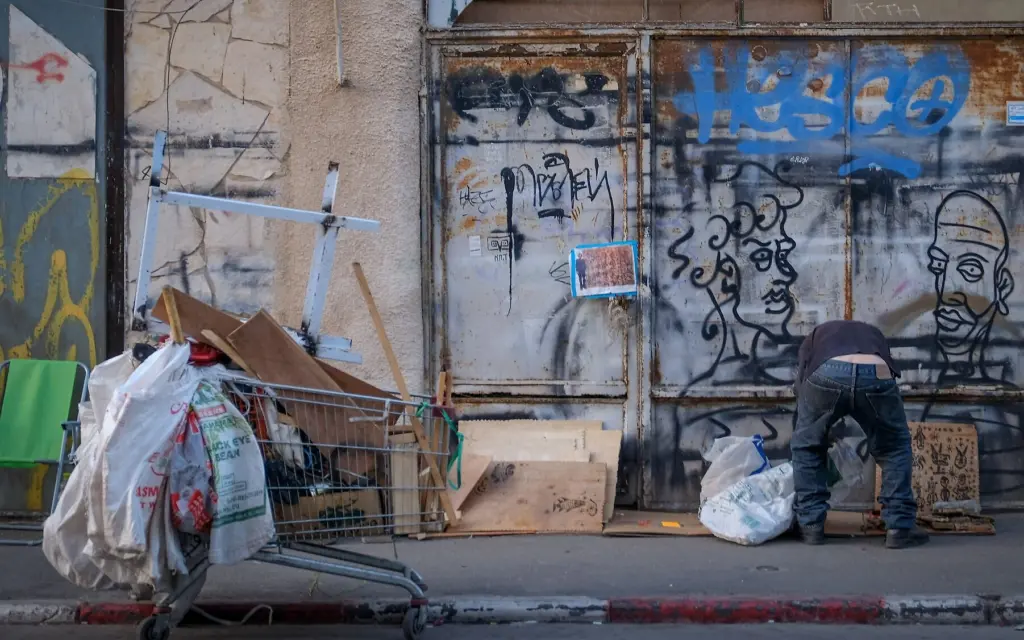
In kitchens across Israel, from the modest flat in Netanya to the suburban home near Haifa, an unsettling quiet has begun: families are cutting back—on fresh produce, on meat, on the notion of a secure future in the Jewish state. Behind the walls of the “Startup Nation” lies a landscape of anxiety: more than a quarter of households now report that they cannot reliably afford adequate food; meanwhile, a significant number of Israeli Jews are choosing to leave the country entirely.
According to recent data from the National Insurance Institute (NII), in 2024 approximately 27 % of Israeli households were classified as living with food insecurity. The exact number of individuals is often cited as “almost 3 million Israelis, including one million children”. Although combined figures include all groups, breakdowns for Jewish households show that about 19 % of non-Haredi Jewish households and 25 % of Haredi Jewish households were facing food-insecurity.
At the same time, emigration is accelerating. A recent report to the Knesset Research and Information Center found that between early 2022 and mid-2024 more than 125,000 Israeli citizens left the country with no intention to return — the largest such exodus on record. In 2022 some 59,400 Israelis departed; in 2023 roughly 82,800; and in the first eight months of 2024 nearly 50,000.
The implications for the Jewish majority in Israel are deep: what was once portrayed as the refuge and homeland for Jews worldwide is increasingly failing to guarantee basic security of livelihood for many, and prompting a quietly growing “yedida” (descent) of formerly “aliyah”-bound populations.
The hunger of a nation
Even in a country of ten million people with a famous high-tech sector and global brand, food insecurity is no longer a fringe issue. For many Jewish Israeli families this has become a daily challenge.
According to the NII’s figures, which are summarised in Israeli media, income stagnation, rising cost of living, inflation, and a heavy burden of housing and security costs are squeezing household budgets. Social welfare programmes are under pressure, and non-profit food-aid groups report increased demand.
The factor of children is especially troubling. While specific numbers for Jewish households remain incomplete, media reportage cites “one million children” among the nearly three million people unable to sufficiently afford food in 2024. That indicates a significant impact on the next generation.
For many Jewish families, the narrative of Israel as a land of upward mobility and economic opportunity is shifting. A growing number quietly ask: Can we stay here?
A middle-class exodus begins
It is not only the lowest-income families who are unsettled. Interviews with secular Jewish professionals and reports from Israeli media make clear that a new wave of departures is underway—by those who have the skills, the passports, the means to leave.
In February 2024 the US-based publication Forward reported on secular Jewish Israelis who said the war of October 7 2023, along with waves of domestic unrest and runaway living costs, became the “last straw”.
“There’s no shame in it,” said Sarah Mann, a 55-year-old editor in Tel Aviv weighing whether to take a few-month break from the country or leave it altogether. “Are you kidding? This is a matter of survival.”
In October 2024 The Guardian described the flight of the country’s secular elite:
“The main reason we are leaving is that we are seeking a better future for our children… The war increased the urgency of the search.”
Young Jewish couples, especially those with dual passports or foreign ties, are moving to Germany, the Netherlands, Spain, Norway, Canada or the US. They cite economic opportunity, lower cost of living, and a more stable lifestyle than the open-ended security and political risks they face in Israel.
According to a March 2025 report by the Institute for Jewish Policy Research, there are now about 630,000 Jewish people born in Israel or who have lived there significantly now living abroad; add children born overseas and the figure approaches one million. The wave is most visible in Europe, where Jewish communities are being “rejuvenated” by the arrival of Israeli-born Jews.
While numbers do not yet signal collapse, the trend is altering the demographics of the Jewish state and posing a challenge to the Zionist narrative of “ingathering of the exiles”.
Disillusionment among the old-guard
One of the more striking features of the emerging story is that many departing Jews are not recent immigrants—they are the children or grandchildren of the major waves of immigration from Eastern Europe, the USSR and North Africa in the 1940s-50s and 1990s.
These were the generations who believed in the Zionist promise: build the Jewish homeland; work hard; succeed. Today, many of them believe that promise has unravelled.
They point to:
- Economic decline: high cost of living, housing shortages, heavy tax burdens, wage stagnation.
- Security fatigue: ongoing military conflict, mass casualty wars, repeated missile threats and military mobilisations make life unpredictable.
- Social-political drift: the rise of religious conservatism, deep ideological divides, judicial changes and concerns about democratic regression.
- Identity glitches: for some, the sense of belonging to a vibrant Jewish state has shifted into feeling captive in a besieged state.
One interviewee, “Noam” (name changed) told The Guardian:
“If you ask me what we are headed for, you can look at the Iranian model … Even without the enemies we have all around [the region], that’s a good enough reason for any child-loving parent to take his children away from harm.”
The idea of leaving once carried stigma in Israel—the term “yordim” (“those who go down”) was used derogatorily to describe those who departed. Now, leaving is becoming more accepted; many think of it as a reassessment of where they can build a stable, free life for their children.
The ideological consequences
What does this mean for Israel’s character, its economy, its future? The consequences are many:
Demographics & social contract
A key pillar of Zionism has been maintaining a Jewish majority, developing the land, absorbing new immigration. If middle-class Jewish families leave for greener pastures, the burden will increasingly fall on lower-income sectors, including the ultra-Orthodox and Arab Israeli minority. The social balance may shift in ways the state was not built to accommodate.
Economic risks
While Israel boasts a high-tech sector, that industry employs a small fraction of the workforce. Analysts warn that if skilled professionals leave en masse, the “brain drain” may erode the innovation base that the economy depends on. The war economy and security spending also divert resources from investment and social infrastructure.
Ideological erosion
The narrative of “never again” and “a safe haven for Jews” rests not merely on security but on prosperity, opportunity and dignity. If Jews who have the means to leave believe that Israel no longer delivers that promise, the very foundation of the Zionist project may lose legitimacy among its key constituencies.
Conflict and occupation
Finally, there is a moral dimension. Many Jews who came to Israel in the post-1948 era built lives on the fruits of that project—even as the displacement of Palestinians remained unresolved. As more depart, the question of who will inhabit and sustain the state, and at what cost, becomes sharper.
On the ground – stories of exit
Tel Aviv, 2025 – Sara & Yossi (38 and 40) sold their three-bedroom apartment in the city’s north, saying they could no longer afford the mortgage, daycare and security costs while feeling future prospects dim. They relocated their two children to Berlin, where Yossi found a software job and Sara enrolled in a German-language graduate programme. “We loved Israel; we believed in it,” Sara says. “But lately it felt like we were tethered to a pressure-cooker state. Here we have breathing room.”
Haifa region, 2025 – David (44) is a rejected Soviet-Jewish child-immigrant of the 1990s, now a finance executive. “Every generation after ours came to believe the story: ‘you build, you grow, you flourish’. Now I keep asking: is that still true? When I go to my parents’ kibbutz I see stagnation. The cost of raising kids is too high. The war is on again. I figured: if not now, when? So we moved the family to Amsterdam.”
First generation story – Miriam (67) emigrated from Ukraine to Israel in 1955. Her children built lives in Israel, but now two of her grandchildren have moved back to Warsaw and Vilnius, citing high costs and the pull of Europe’s stability. She says quietly: “I came to Israel believing this would be my home. But when I visit now, I feel like I’m staying less and less. The land is the same, but the map of hopes has changed.”
These are not apocalyptic mass departures yet. But for every family that stays, and tightens their belts, there is another quietly planning their exit. And the sum of those individual decisions may yet reshape the country.
What Israel could do — and what it might lose
To turn the tide, the Israeli government and society face major tasks:
- Improve household economic security: Direct subsidies, cost-of-living relief, wage growth especially outside the hi-tech bubble, deeper social welfare support for Jewish low/middle-income households.
- Stabilise the social contract: Rebuild public trust in government responsiveness, protect liberal democratic institutions, reaffirm a vision that offers not just survival but flourishing.
- Retain talent and families: Investment in regional centres, reducing housing/cost burdens, creating opportunities for young Jewish professionals who might otherwise consider leaving.
- Reframe immigration/emigration dynamics: Recognise that not only incoming “aliyah” matters but also retention of Israelis. The demographic strategy must account for those who may leave.
- Reimagine the Zionist story: Acknowledge that material conditions, not just ideological ones, anchor Jewish settlement in Israel. If Israel wants to sustain its Jewish majority and global Jewish confidence, it must deliver on economic dignity, not just military security.
If nothing changes, the stakes are high: Israel risks not just social and economic decline, but a fundamental shift in identity. The exodus of citizens isn’t just moving boxes across borders — it is a sign that the story of Israel for many Jews is losing its promise.
For decades the story of Israel was straightforward: Jews dispersed, Israel gathered. Today, that story is showing new contours — Jews are leaving, not only because of conflict, but because of economics, ideology and ease of exit. For the Jewish majority in Israel, the questions are multiplying: Will we be able to feed our children? Will we be able to build a secure, prosperous life here? And if not, will we stay?
Whether this becomes a trickle or a tide depends on decisions made in the coming months and years: not only economic and policy decisions, but decisions of identity, belonging and hope. For now, one of the world’s most enduring national projects is coming under pressure from inside its own households.