


A solidarity demonstration outside HMP Pentonville descended into tragedy after a violent altercation involving a pro-Israel counter-protester was followed minutes later by the sudden death of a well-known London community journalist — an event that has been entirely ignored by all major UK news outlets.
The demonstration on Saturday 15 November was held to support six Palestine Action detainees who have begun what is rapidly becoming the largest prisoner hunger strike in Britain since the 1981 protests led by Bobby Sands. But as tensions flared on the pavement outside the north London jail, a respected independent videographer collapsed and died while documenting the events.
A confrontation, a collapse, a cordon — and media silence
Eyewitnesses identified the man who died as David Lear, 55, a well-known independent journalist, protest videographer and longtime documentarian of Palestine solidarity movements.
Moments before his collapse, David had been filming an altercation in which a man described by protesters as a far-right, pro-Israel agitator confronted demonstrators. The counter-protester was arrested by police immediately afterwards.
Witnesses say David was attempting to record the confrontation — something he had done countless times before — when he suddenly collapsed. He had previously survived a heart attack, wore a pacemaker, and was suffering from pneumonia, yet insisted on attending the protest to support the hunger strikers and document what mainstream outlets would not.

David attended previous Palestine marches in London and interviewed demonstrators
Emergency services attempted CPR, assisted by a passing nurse, but David could not be revived. Police then sealed off Caledonian Road, which independent journalist Danish Khan described as a “major incident”.
Despite the seriousness of the events — a violent altercation, a sudden death, and a major police response — every national news organisation has remained silent.
Tribute to David Lear: “A real community champion”
David’s close friend and trade-union figure Steve Hedley published a powerful tribute hours after his death:
“My great friend David Lear, an absolute hero, passed away today whilst doing what he loved — filming the Palestine demo at Holloway Road.
After seeing a young woman assaulted by a racist thug, David went to capture the bully on film and suffered a heart attack.
Despite attempts to revive him by police paramedics and a passing nurse, David could not be resuscitated.
Deepest condolences to his children and all his family and friends.
David reported on stories others were too frightened or corrupt to cover — a real community champion who literally spent his final moments fighting injustice.”
His death has sent shockwaves through activist networks that had relied on him for years to record events accurately and fearlessly.
David Lear — the independent journalist the mainstream ignored
A grassroots filmmaker and protest videographer
David Lear was a north London-based independent journalist and filmmaker whose work focused on the realities of protest movements, policing, and grassroots community action. He operated largely outside traditional newsrooms and was closely associated with IFN Media (Islington Free News Media) — a small but respected local social-news outlet.
He served as:
- field cameraman
- interviewer
- protest documentarian
- on-the-ground correspondent
His most prominent Palestine-related work was the IFN Media feature “Grieving for Gaza”, filmed at the National Gallery. He covered performance-art activism, interviews, and testimonies highlighting the struggle of injured Palestinian children denied UK medical visas.
Work beyond Palestine
David also contributed footage to Politics This Week, including segments on nationwide protests, farmers’ marches, and local community mobilisations.
Deeply embedded in community reporting
Activist groups described him as:
- “always seen with a camera in hand”
- “ever-present at Palestine protests for two years”
- “a frontline witness to what mainstream media wouldn’t show”
He participated in online political discussions surrounding:
- Palestine Solidarity Campaign
- Stop the War Coalition
- regional Palestine solidarity groups
- Middle East Monitor commentary
A chronicler of struggle
Unlike mainstream correspondents, David had no editor and no institutional backing.
He was part of a small but vital tradition of citizen journalism — people who record the political realities that more powerful institutions prefer not to publicise.
He died doing the work he believed in.
The largest prisoner hunger strike in decades
The protest outside Pentonville was held in solidarity with six Palestine Action detainees who have launched an open-ended hunger strike inside the UK prison system:
- Amu Gib
- Heba Muraisi
- Jon Cink
- Kamran Ahmed
- Teuta “T” Hoxha
- Qesser Zurah
All six are held on remand — none has been convicted of a crime. Several have already spent over a year behind bars, and most face up to two years’ imprisonment before trial due to counter-terror scheduling. This exceeds the normal UK pre-trial custody limit of 182 days by more than 400%.
Their demands include:
- immediate bail
- an end to isolation and mail censorship
- release of withheld legal documents
- de-proscription of Palestine Action
- and the closure of all UK sites of Elbit Systems, Israel’s largest weapons manufacturer
Campaign group Prisoners for Palestine says 33 more prisoners across the UK are preparing to join — making this Britain’s largest prison hunger strike since 1981.
Allegations of abuse, isolation and religious harassment
Multiple hunger strikers report:
- physical violence by guards
- punitive non-association orders
- confiscation of keffiyehs and prayer garments
- withheld letters, books and legal papers
- repeated verbal abuse, including being called “terrorists”
- overcrowded, overheated and unsanitary conditions
HMP Bronzefield denies the allegations.
HMP Pentonville, where Ahmed is held, was placed under special measures after being described as “cockroach-infested”.
The Filton 24: a turning point in the criminalisation of dissent
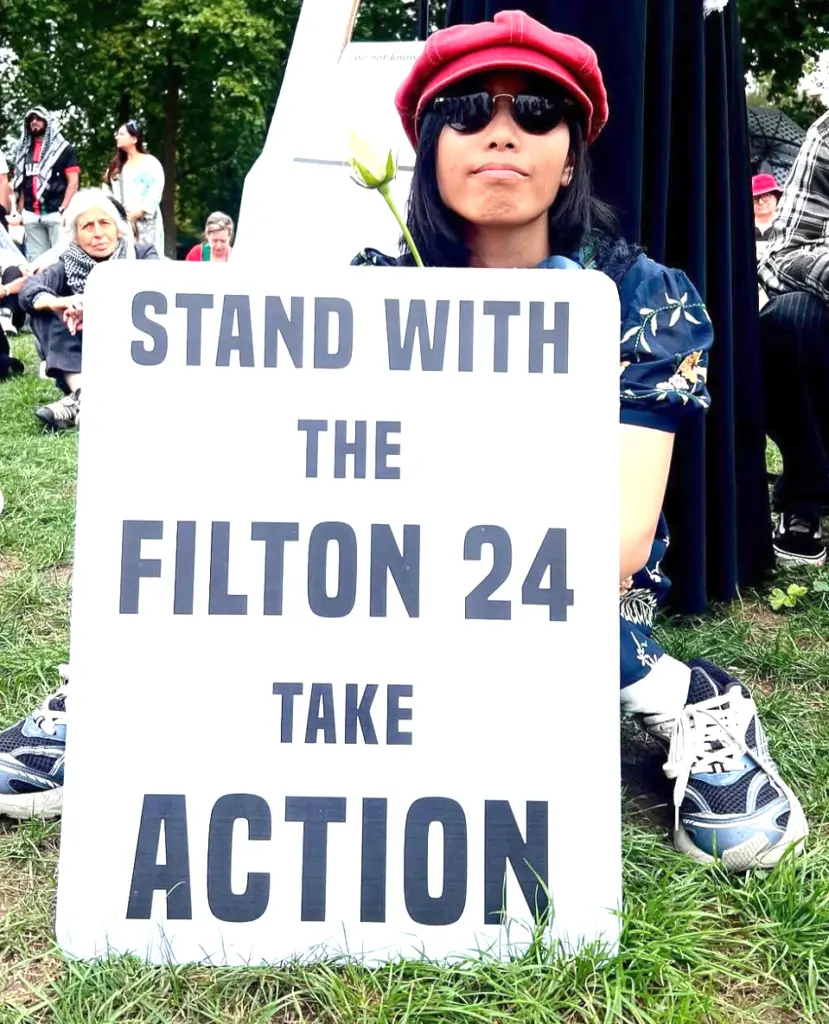
Four of the hunger strikers — Ahmed, Hoxha, Muraisi, and Zurah — are among the Filton 24, activists charged over a 2024 direct action against an Elbit Systems factory in Gloucestershire.
Their case has become symbolic of a wider national shift:
- the use of terrorism laws against non-violent activists
- unprecedented lengths of pre-trial detention
- mass arrests of supporters under terror legislation
- aggressive policing of Gaza solidarity protests
More than 2,100 people have been arrested for protesting the ban on Palestine Action — including clergy, veterans and disabled protesters.
A High Court challenge to the proscription begins on 17 November.
International solidarity, domestic silence
Support continues to grow:
- In New York, activist Jakhi McCray has begun a solidarity fast.
- In Lebanon, former political prisoner Georges Abdallah has endorsed the strike.
- Prisoners in several UK jails have refused food or work.
But in the UK itself, the silence is deafening.
The hunger strike, the violent confrontation, the police cordon, and the death of a respected journalist — all remain completely unreported by mainstream broadcasters and newspapers.
For campaigners, the silence is not accidental.
It is political.
“Cruel to the public”
Hunger striker Teuta “T” Hoxha told Novara Media:
“I need rehabilitation from prison.
It’s not just cruel to prisoners —
it’s cruel to the public to believe this experience offers any rehabilitation.”
As the hunger strike grows, as more prisoners join, and as the state doubles down on counter-terrorism powers, the UK is entering a political confrontation not seen in decades — one rooted in Gaza, protest rights, and who gets to tell the truth.