


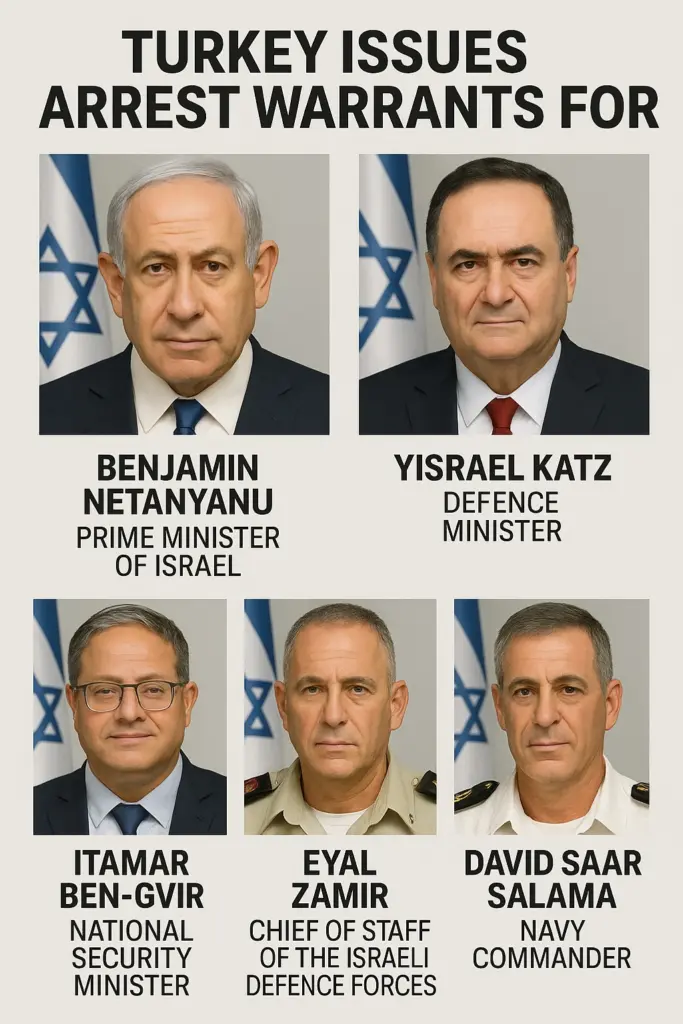
Turkey has issued arrest warrants for 37 senior Israeli officials, including Prime Minister Benjamin Netanyahu, Defence Minister Yisrael Katz, National Security Minister Itamar Ben-Gvir, Chief of Staff Eyal Zamir, and Navy Commander David Saar Salama, accusing them of genocide and crimes against humanity during Israel’s war in Gaza.
The announcement, made by the Istanbul Chief Public Prosecutor’s Office on November 7, 2025, follows a year-long investigation into alleged systematic attacks on civilians, hospitals, and aid convoys in the Gaza Strip. It marks one of the boldest applications of universal jurisdiction in recent decades and places Israel’s top leadership under formal international scrutiny.
Genocide Allegations
According to the Turkish prosecutor’s office, the investigation found that between October 2023 and October 2025, Israeli political and military leaders engaged in “systematic acts of genocide and crimes against humanity.”
The allegations focus on a series of incidents, including:
- The October 17, 2023 bombing of Gaza’s Al-Ahli Baptist Hospital, which killed more than 500 people.
- The March 2024 destruction of the Turkish-Palestinian Friendship Hospital.
- The blockade and deprivation of humanitarian aid to civilians throughout 2024 and 2025.
- Targeted attacks on medical facilities, schools, and journalists.
The statement added that the accused “deliberately used starvation, deprivation, and collective punishment as methods of warfare,” and that such acts constitute genocide under both Turkish and international law.
Under Turkish law, genocide and crimes against humanity have no statute of limitations, and jurisdiction can be asserted regardless of nationality or where the crimes occurred.
Universal Jurisdiction and Legal Significance
The warrants are based on the doctrine of universal jurisdiction — a principle allowing states to prosecute certain grave crimes committed abroad. This approach mirrors the International Criminal Court’s 2024 warrants for Netanyahu and former Defence Minister Yoav Gallant, which accused Israel of similar violations during the Gaza campaign.
Turkey’s move signals its determination to pursue accountability where international institutions have faltered. It also underscores Ankara’s long-standing support for the Palestinian cause and President Recep Tayyip Erdoğan’s insistence that Israel’s campaign in Gaza represents “the most brutal massacre of the 21st century.”
Israel’s Response
Israel has condemned the warrants as politically motivated. Foreign Minister Gideon Sa’ar dismissed the move as “a publicity stunt,” accusing Ankara of weaponising international law for propaganda purposes. Israeli officials said the decision has no legal standing outside Turkey and vowed to protect their leaders from arrest abroad.
Nonetheless, the warrants may complicate international travel for the named officials, especially to countries maintaining extradition treaties or judicial cooperation with Turkey. Several Israeli media outlets reported that legal advisers have already warned officials against travelling to jurisdictions where the warrants could be enforced.
Palestinian and International Reaction
The Palestinian Foreign Ministry welcomed Turkey’s decision as “a victory for the principle of justice,” urging other nations to follow suit. Human-rights groups called the move a breakthrough in the global effort to hold Israeli leaders accountable, while Western diplomats described it as largely symbolic.
Legal scholars noted that even symbolic actions can carry weight, restricting mobility and increasing political pressure. “These warrants place a legal marker in the record of history,” one international law expert said, “and that alone can influence future prosecutions.”
Chances of Enforcement
While the likelihood of arrests remains low, Turkey’s step could still have far-reaching implications. The officials named are unlikely to visit Turkey or nations that cooperate closely with its judiciary. Still, the issuance of warrants may prompt third-party states to re-evaluate their own legal obligations under universal jurisdiction principles.
The Istanbul prosecutor confirmed that the warrants have been forwarded to international policing authorities, and Turkey is expected to request Interpol red notices within the coming week. Whether Interpol acts remains uncertain, as such requests often depend on political consensus.
Implications for Diplomacy and International Law
The warrants further strain Israel-Turkey relations, already tense since Ankara expelled the Israeli ambassador in May 2024 amid mass protests over the Gaza war. The move may also complicate future negotiations over Gaza’s reconstruction, in which Turkey has sought a leading role.
Diplomatically, the decision signals to other governments — particularly in Europe and the Global South — that Turkey intends to assert leadership in the legal fight against impunity. If any country acts on these warrants, it could set a major precedent for the practical use of universal jurisdiction.
However, without enforcement, the case risks remaining a political gesture — powerful in symbolism but limited in immediate legal effect.
How Turkey’s Universal Jurisdiction Law Works
- Legal Basis: Under Turkey’s Penal Code, crimes such as genocide, war crimes, and crimes against humanity are exempt from statutes of limitation and can be prosecuted even if committed abroad by non-Turkish citizens.
- Jurisdiction: Turkish courts claim jurisdiction over these crimes under international treaties ratified by Turkey, including the Genocide Convention and the Geneva Conventions.
- Process: Prosecutors may open investigations based on evidence submitted by victims, NGOs, or state institutions. Once a warrant is issued, it can be circulated internationally through Interpol or bilateral legal channels.
- Limitations: Enforcement depends on cooperation from other states. Unless a suspect travels to a jurisdiction willing to act, warrants remain unenforced but carry symbolic and diplomatic weight.
What Comes Next
- Turkey is expected to seek Interpol cooperation and potentially request extradition in select jurisdictions.
- Palestinian advocacy groups are preparing to submit complementary cases in European courts in late 2025.
- Ankara plans to host an international conference on post-war accountability and Gaza reconstruction in early 2026.
- Israeli officials are reportedly reviewing travel restrictions and diplomatic protocols to prevent detentions abroad.
Turkey’s issuance of 37 arrest warrants marks a historic moment in the evolving pursuit of accountability for alleged war crimes in Gaza. While actual arrests may never occur, the legal and moral weight of the decision cannot be easily dismissed.
For Palestinians, it represents long-delayed recognition. For Israel, it is a legal and diplomatic challenge. And for the international community, it is a reminder that the world’s patience with impunity — even for powerful states — is wearing thin.
As of November 2025, the Turkish case remains active. The 37 Israeli officials named — led by Benjamin Netanyahu — now face the possibility, however remote, of arrest for alleged genocide and crimes against humanity.