


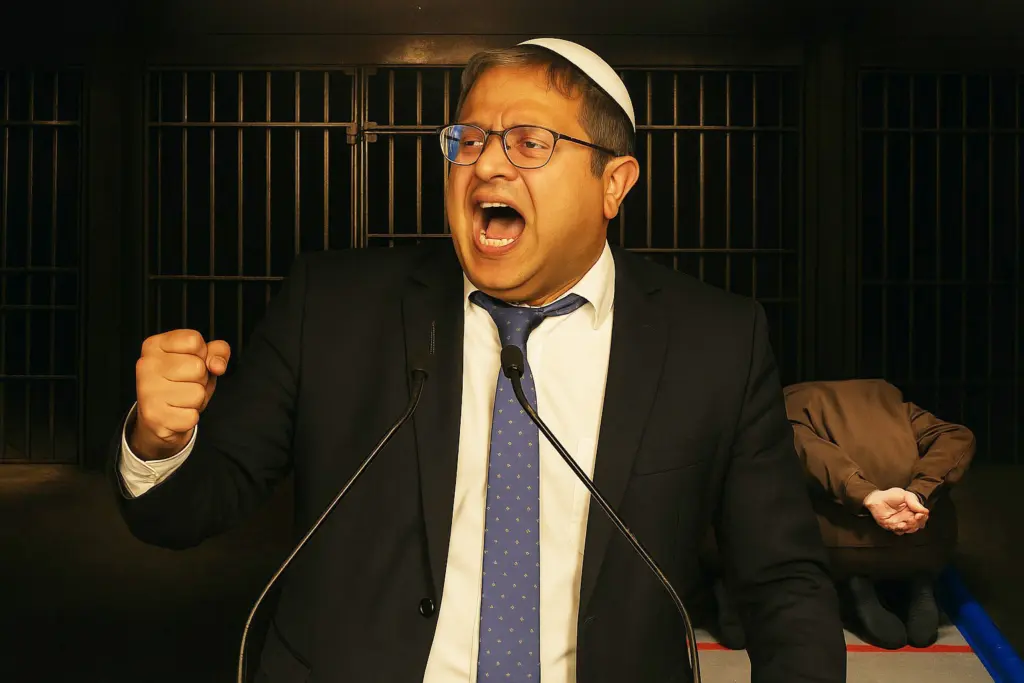
Israel’s far-right national-security minister Itamar Ben-Gvir has turned a prison once condemned by Israel’s own authorities as too cruel for human confinement into a personal monument to punishment and power.
The underground jail — known as Rakefet — was shut down in the mid-1980s for violating basic human standards, yet reopened under Ben-Gvir’s orders to hold Palestinians from Gaza in permanent darkness, without charge or trial, and under conditions lawyers describe as torture.
Among those trapped below ground are a 34-year-old nurse, arrested while still wearing hospital scrubs, and an 18-year-old food seller, seized at an Israeli checkpoint. Both have been held since January and have not seen daylight for nearly a year, according to lawyers from the Public Committee Against Torture in Israel (PCATI).
A Minister Once Convicted of Terrorism-Related Offences
Iraqi immigrant to Palestine, Ben-Gvir, who now oversees Israel’s entire prison system, was himself prosecuted and convicted in 2007 by the Jerusalem Magistrate’s Court for supporting a Jewish terrorist organisation — the outlawed Kach movement — and for incitement to racism.
The convictions stemmed from public placards reading “Rabbi Kahane was right” and “Expel the Arab enemy.” Prosecutors considered seeking a custodial sentence; court archives do not specify the final term. In an earlier 2004 case, he was fined 1,300 NIS for similar extremist propaganda. Major profiles list multiple convictions, including for supporting a terrorist organisation and incitement to racism; Israel’s Supreme Court later recorded that those entries were erased in 2021 under the Criminal Records and Rehabilitation Law.
The man now running Rakefet — once judged unfit for human use — is therefore a minister previously convicted of supporting terrorism.
A Dungeon Resurrected
Rakefet — meaning “cyclamen flower” in Hebrew — lies beneath the Ramla prison complex southeast of Tel Aviv. Built in the early 1980s to confine organised-crime figures, it was designed for just 15 inmates.
Even that limited experiment ended quickly: prison chief Rafael Suissa shut it down after concluding that underground confinement was “too cruel, too inhumane for any person to endure.” Now, according to official data obtained by PCATI, Rakefet holds around 100 Palestinian detainees — nearly seven times its intended capacity. All are confined below ground, with no natural light or ventilation.
“Until the War Ends”
When PCATI lawyers Janan Abdu and Saja Misherqi Baransi visited in September, they were led by masked guards down grimy stairs into a suffocating corridor deep beneath the surface. Their clients — the nurse and the teenager — were brought in bent double, shackled hand and foot, heads forced downward. Guards warned that any mention of families or Gaza would end the meeting.
The 18-year-old told Abdu: “You are the first person I have seen since my arrest.” His last words: “Please come see me again.” The nurse, a father of three, asked: “Where am I and why am I here?” Judges in brief video hearings, held without counsel, ordered both men held “until the war ends.”
Life Without Sunlight
Every part of Rakefet — cells, corridors, even the so-called “exercise yard” — lies underground. Detainees live entirely without sunlight or fresh air. Mattresses are confiscated at 4 a.m. and returned late at night. Prisoners are allowed outside their cells for only a few minutes every other day, into a small concrete enclosure with no view of the sky. They report beatings, dog attacks, starvation-level rations, and lack of medical care.
Last month Israel’s High Court ruled that the state was depriving Palestinian prisoners of adequate nutrition — confirming systemic abuse across the prison system.
“Rakefet imposes a unique form of suffering,” said Tal Steiner, PCATI’s executive director. “Keeping people underground without daylight destroys body and mind. It is deliberate cruelty — a form of torture.”
From Gaza to the Underground
Across Israel’s prisons, at least 9,600 Palestinians are currently detained or serving sentences on “security” grounds — including more than 2,200 from Gaza, according to B’Tselem.
Under the October 2025 ceasefire, Israel released about 1,950 detainees, yet roughly 1,000 others remain in indefinite detention under emergency wartime powers.
“When I told the nurse, ‘Your mother is alive and she authorised me to see you,’ he cried,” said Misherqi Baransi. “It was the first news from home he’d heard in nearly a year.”
When the teenager asked if his pregnant wife had given birth, guards silenced him. As he was led away, Abdu heard the rumble of an elevator — suggesting the cells lie even deeper underground.
A Ministry of Cruelty — Publicity Visits and Taunts
Ben-Gvir has not confined his role to policymaking: he frequently personally visits detained prisoners, films those visits, and posts footage publicly — often using them as performative displays of punishment.
In August 2025 he posted a short video of a prison meeting with veteran Palestinian leader Marwan Barghouti, in which he can be heard delivering menacing remarks to a visibly gaunt Barghouti; the clip drew international condemnation and outrage from Palestinian officials and rights groups.
In October 2025 he publicly toured detention facilities holding activists from a recently intercepted Gaza flotilla, then posted footage and comments in which he derided the detainees and said he was “proud” of their harsh treatment — a move criticised by legal aid groups and rights organisations as an endorsement of abuse.
Ben-Gvir’s prison-side performances have been described by critics as public intimidation — a deliberate blurring of punishment, political theatre, and propaganda. Rights organisations say filming and broadcasting such interactions violates detainees’ dignity and crosses into dehumanising, retaliatory conduct.
Buried Alive
Ben-Gvir has made punishment of Palestinians the centrepiece of his politics: cutting meals, restricting family visits, boasting of overcrowding.
Israel’s own security agencies have warned that such abuse endangers national security. The Prison Service declined to answer questions, saying only that it operates “in accordance with the law.”
The Justice Ministry referred inquiries to the military, which referred them back.
For the 18-year-old civilian still buried beneath Rakefet, politics above ground mean nothing. He has not seen the sun since his arrest. He does not know when — or if — he will ever emerge.
Rakefet Prison: The Numbers
| Category | Figure / Detail |
|---|---|
| Original capacity | 15 prisoners |
| Current population | ≈ 100 Palestinian detainees |
| Overcrowding | ~7 × capacity |
| Environment | Entirely underground – no daylight |
| Reopened | After 7 Oct 2023 attacks, by order of Ben-Gvir |
| Detainee profile | Mostly Gaza civilians – nurse & 18-year-old seller |
| Palestinians in custody overall | 9,619 (Dec 2024) |
| From Gaza | 2,216 |
| Released under ceasefire | 1,950 (1,700 detainees + 250 prisoners) |
| Still held without charge | ≈ 1,000 |
Built for 15, now holds ≈ 100 in darkness.
Nearly 10,000 Palestinians remain detained nationwide, many uncharged.
Rights lawyers call Rakefet “institutionalised torture.”
Timeline: From Closure to Ben-Gvir’s Reopening
Early 1980s – Construction of subterranean Rakefet (capacity 15).
1985 – Closed for inhumane conditions by IPS chief Rafael Suissa.
1990s–2000s – Facility sealed and forgotten.
2007 – Ben-Gvir convicted of supporting a terrorist organisation (Kach) and incitement to racism.
Oct 2023 – Reopened under Ben-Gvir after Hamas attack.
Jan 2024 – First Gaza civilians transferred (34-year-old nurse, 18-year-old vendor).
Sept 2025 – PCATI lawyers document 100 detainees in cells built for 15.
Oct 2025 – High Court rules food deprivation unlawful.
Summary: Closed 40 years ago for cruelty, revived by a minister once convicted of supporting terrorism.
Rakefet and International Law
| Principle | Legal Basis | Violation at Rakefet |
|---|---|---|
| Freedom from Torture | UN CAT Arts 1 & 16; ICCPR Art 7 | Beatings, starvation, sensory deprivation |
| Arbitrary Detention | ICCPR Art 9; Geneva IV Arts 42 & 78 | Held “until war ends” without charge |
| Collective Punishment | Geneva IV Art 33 | Mass detention of Gaza civilians |
| Enforced Disappearance | ICPPED Arts 2–3 | Families denied location info |
| Incommunicado Detention | UN Detention Principles 15–19 | No family or lawyer contact |
| Medical & Nutritional Neglect | Geneva IV Art 91; Mandela Rules 24–27 | Starvation & lack of care |
| Discrimination & Persecution | ICCPR Art 26; Rome Statute Art 7(h) | Harsher regime for Palestinians |
| Deprivation of Light & Air | ICRC Rules 90 & 118 | Total absence of sunlight and air |
Rakefet violates at least eight core human-rights standards and may constitute torture and crimes against humanity under the Rome Statute.
Itamar Ben-Gvir: International Legal and Human Rights Scrutiny (2023 – 2025)
I. Overview
Far-right Jewish Power (Otzma Yehudit) leader and Israel’s Minister of National Security since 2022, Itamar Ben-Gvir has become a focus of UN, ICJ, and ICC concern for alleged incitement, apartheid policies, and collective punishment of Palestinians.
II. International Criminal Court (ICC)
- Investigation: Formal probe into the “Situation in the State of Palestine” (2014–present).
- Legal filing: In December 2023, Dr Omer Shatz submitted a communication accusing senior Israeli officials, including Ben-Gvir, of public incitement to genocide.
- Draft warrants: Reports in May 2024 said ICC Prosecutor Karim Khan had prepared draft arrest applications for Ben-Gvir and Finance Minister Bezalel Smotrich; none have been formally filed.
- Status: Under review — no charges issued. Possible counts: incitement to genocide, persecution, population transfer.
III. International Court of Justice (ICJ)
- Ben-Gvir is named in Qatar’s July 2023 submission and referenced in other filings by Jordan as an example of official incitement.
- ICJ provisional measures (Jan and May 2024) ordered Israel to prevent and punish direct public incitement to genocide — implicitly including senior officials like Ben-Gvir.
IV. United Nations Findings
- The UN Human Rights Council’s Commission of Inquiry (Oct 2024) cited Ben-Gvir’s rhetoric as fuelling settler violence.
- UN General Assembly reports (2023–2024) noted his eight criminal convictions and repeated provocations at holy sites.
- UN Special Rapporteurs (2024–2025) warned that his rhetoric “risks constituting incitement to atrocity crimes.”
- A September 2025 UN report linked his policies to annexation and demographic engineering in the occupied territories.
V. National and Legal Responses
- In mid-2025, the UK, Australia, Canada, New Zealand, and Norway imposed personal sanctions on Ben-Gvir and Bezalel Smotrich for incitement and settlement expansion.
- Independent legal experts at the International Centre of Justice for Palestinians (ICJP) have argued his statements meet the threshold for direct and public incitement to genocide under Article 25(3)(e) of the Rome Statute.
VI. Status Summary (Nov 2025)
| Forum | Allegations / Focus | Status |
|---|---|---|
| ICC | Incitement to genocide; apartheid; population transfer | Under investigation – no warrant |
| ICJ | State obligation to prevent incitement | Named in Qatar & Jordan filings |
| UN HRC / COI | Incitement of violence & settler attacks | Explicitly condemned |
| UN GA Reports | Provocations at holy sites; hate speech | Documented 2023–24 |
| National Governments | Sanctions for hate rhetoric & settlements | Imposed June 2025 |
While neither the ICJ nor ICC has issued personal rulings against Ben-Gvir, his record of incitement, convictions, and policy choices place him under unprecedented international scrutiny.
Across UN, ICJ, and ICC forums, his name recurs as a case study in state-sponsored incitement and collective punishment — and as a potential future subject of international criminal accountability.
“Holding people underground without daylight destroys body and mind. It is deliberate cruelty — a form of torture.”
— Tal Steiner, Executive Director, Public Committee Against Torture in Israel