


On 4 November 2025 — almost two years after the events of October 7 — the BBC quietly replied to a complaint first submitted in January 2024. The complaint concerned factual inaccuracies in a BBC News website article titled “Eisenkot: Key Israeli war leader challenges Netanyahu over Gaza strategy.”
At the time, the BBC stated:
“Hamas killed around 1,300 people, mostly civilians…”
Israel has since revised the figure downward to approximately 1,100, and Israeli government breakdowns now recognise that a significant proportion were active-duty soldiers, reservists, former soldiers, armed civilian squad members, or individuals with formal military status.
More extraordinary is the BBC’s new response:
“We have no reliable evidence about any deaths from friendly fire incidents…”
This is contradicted by:
- official Israeli admissions
- Israeli police testimony
- Israeli survivor interviews
- Israeli military investigations
- UN findings
- the forensic destruction of evidence
- the operation of the Hannibal Directive
The BBC’s reply reads less like an editorial judgement and more like a government talking point.
Not “hostages”: prisoners of war
The October 7 operation targeted military installations across illegally occupied Palestinian territory. Hamas stated openly that its objective was to seize soldiers to exchange for the thousands of Palestinians held without charge — including women and children — under Israel’s administrative detention regime. Torture, disappearance, and deaths in custody are extensively documented.
Under international humanitarian law, captured soldiers are prisoners of war (POWs).
The refusal by Western media — including the BBC — to use this terminology is not editorial neutrality. It is political alignment.
The Hannibal Directive
The central structural cause of Israeli-on-Israeli deaths on October 7 is the Hannibal Directive — a doctrine instructing Israeli forces to prevent the capture of Israelis even if this results in their death.
Though formally rescinded in 2016, multiple Israeli investigative reports confirmed Hannibal-style orders on October 7, including:
“No vehicle returns to Gaza.”
Those vehicles carried POWs.
Some were hit by tank rounds and helicopter fire.
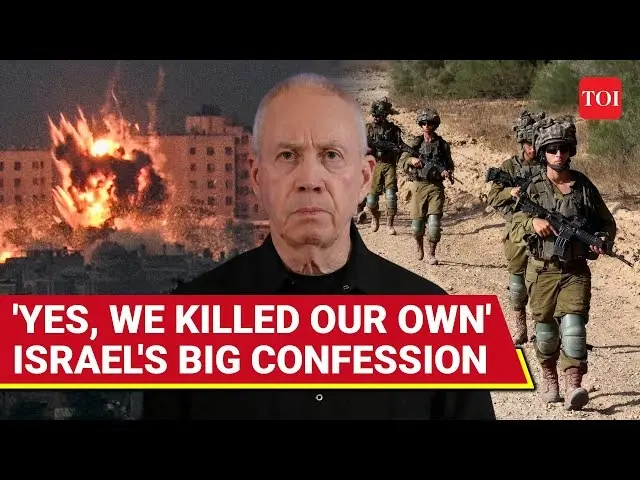
On 7 February 2025, this moved from implication to admission.
In an interview with Israel’s Channel 12, former defence minister Yoav Gallant acknowledged that troops were ordered to shoot and kill captive Israeli civilians on October 7. He described the order as having been issued “tactically” and “in various places” next to Gaza — adding that in some areas it was not issued, which he characterised as “a problem.”
Anchor Amit Segal clarified for viewers that the doctrine means to “shoot to kill when there is a vehicle containing an Israeli hostage.” Gallant did not contest the description.
This was the first time a contemporary Israeli minister publicly conceded that troops were ordered to fire on their own people.
It was not an isolated claim. In January 2024, Yediot Ahronot journalists Ronen Bergman and Yoav Zitun reported that a midday, region-wide order was issued on October 7 to invoke Hannibal “even if this means the endangerment or harming of the lives of civilians in the region, including the captives themselves.”
In July 2024, Haaretz traced the Gaza Division order — “not a single vehicle can return to Gaza” — to 11:22 a.m.
This was unprecedented. An internal doctrine originally conceived in the 1980s for soldiers captured on the battlefield was extended to civilians, including those unarmed and fleeing.
Friendly fire Israel admits — and the BBC denies
Despite the BBC’s assertion of “no reliable evidence,” the following are publicly acknowledged:
Be’eri
Israeli tank shells demolished a house containing Israeli POWs. Israeli civilians were killed by their own military. Families blocked demolition to preserve forensic evidence.
Shuja’iyya (December 2023)
Israeli forces killed three shirtless, unarmed Israeli POWs who waved a white flag and shouted in Hebrew.
Efrat Katz
An official IDF inquiry concluded Katz was “most likely killed by Israeli helicopter fire.”
Nova festival / Route 232
Senior police figures told Israeli press that an IDF Apache “apparently” hit festival-goers.
POWs killed by Israeli airstrikes
Israel later admitted that additional POWs were killed by its own bombardment inside Gaza.
Every one of these points is accepted within Israeli discourse.
They are denied only in London.
Buried vehicles: the destruction of forensic evidence
In November 2023, hundreds of burned vehicles — many containing human remains — were buried en masse.
This destroyed:
- fragment signatures
- penetrator angle analysis
- explosive residue comparison
- shrapnel trajectory mapping
- canonical burn-pattern assessment
These are precisely the clues that distinguish:
- Hellfire missiles
- tank multi-purpose rounds
- helicopter 30mm cannon fire
- AK-pattern small arms
The BBC insists there is “no reliable evidence.”
Israel ensured there never could be.
Israel refused to investigate — on moral grounds
When victims’ families demanded a state commission with subpoena power, senior ministers publicly opposed it.
A prominent wartime cabinet member argued that investigating friendly fire was “immoral” and would “assist Hamas.”
Other officials called it:
- “dangerous”
- “divisive”
- “nationally irresponsible”
Israel’s Attorney-General blocked proposals.
No state refuses to count its own dead unless the number is politically catastrophic.
Zikim Beach
The amphibious landing north of Gaza killed 17 civilians and a soldier. Survivor testimony has alleged friendly fire. Israel has never provided a breakdown.
The BBC’s certainty contradicts Israel’s uncertainty.
The scale of Israeli fire on Israelis
Official figures published in early 2025 confirmed that during the fighting on October 7:
- the Israeli Air Force fired 11,000 shells
- dropped more than 500 one-ton bombs
- launched 180 missiles
These were not warning shots.
They were area-saturation munitions in populated zones containing Israeli civilians and POWs.
An independent United Nations inquiry later criticised Israel for refusing access and actively discouraging contact with medical professionals, denying the Commission the basic ability to review forensic evidence.
After October 7: the Israeli media delegations
Within days of October 7, Israeli government delegations visited BBC headquarters, as well as:
- Sky News
- The Guardian
- other major UK newsrooms
Editors present privately described the briefings as:
- directive
- instructive
- prescriptive
- high-pressure
Journalists were told:
- how to describe Palestinian fighters
- never to describe captured soldiers as POWs
- how to frame atrocity allegations
- how to position Israeli bombardment as “defensive”
- how to minimise Palestinian civilian death
The BBC then adopted language that tracks perfectly with the delegation guidance.
This context is indispensable.
Why the language matters
Calling POWs “hostages”:
- removes Geneva protections
- justifies lethal force against captives
- morally normalises Hannibal logic
- obscures state responsibility
- re-frames the massacre narrative
Language is policy.
Why the BBC has failed
The BBC Charter demands:
- due accuracy
- due impartiality
- correction when new facts emerge
- resistance to political pressure
Instead, the corporation asserts certainty where facts are contested, and denies realities its own sources admit.
This is not journalism.
It is narrative containment.
Nearly two years later, the record is clear
Israel killed Israelis:
- with tank shells
- with helicopter cannon fire
- with ground misidentification
- with airstrikes on buildings containing POWs
Israel buried key evidence.
Israel refused an inquiry.
Israel called investigation “immoral.”
Israel’s own former defence minister has now admitted orders to fire on captive Israeli civilians were issued on October 7.
Only the BBC maintains denial.
In late 2023, the fog of war was real. In late 2025, the fog is editorial.
The BBC is no longer reporting what happened.
It is defending what must be believed.
Full BBC Email Response (4 November 2025)
From: BBC Complaints bbc_complaints_website@contact.bbc.co.uk
Date: Tue, 4 Nov 2025 at 09:10
Subject: BBC Complaints – Case Number – CAS-7742362-H7M8C5
Dear Mr Powell,
We’ve been doing an audit of our complaints system and have found some follow up complaints that unfortunately didn’t receive a reply from the newsroom when they were submitted, for which we would like to offer sincere apologies.
Please be assured that your feedback was logged at the time and shared with senior editors via our overnight reports.
However, we do appreciate that you did not receive an editorial response so even though quite some time has elapsed we’d like to provide one now.
You wrote to us in January 2024 about this report: Eisenkot: Key Israeli war leader challenges Netanyahu over Gaza strategy – https://www.bbc.co.uk/news/world-middle-east-68035744
You said in your follow up complaint: “Can you please explain to me and everyone else who is paying your wages to provide us with accurate information exactly how you arrive at the below when you have been told time and time again that your information is categorically incorrect…’Hamas killed around 1,300 people, mostly civilians, in the unprecedented attack on southern Israeli communities on 7 October last year’.”
We changed the casualty figure in this report in February 2024 from 1,300 to 1,200.
We pointed this out in a note at the end of the report:
Correction 13th February: This article wrongly reported that about 1,300 people had been killed following the 7th October attack by Hamas. This was based on counting those who later died from their injuries in addition to the figure of more than 1,200. The article has been amended to now refer to about 1,200 deaths, a figure which includes those deaths and which Israel says is not final.
In your follow up complaint you also said: “I regret to see that BBC News journalists are continuing to perpetuate untruths against the Gaza’s strip’s government… When Israel says several armed groups breached their fence on 7/10 and killed 1,200 Israelis – and the armed wing of the democratically-elected political party that governs the Gaza strip was just one of them.”
We would say that while fighters from other groups took part in the 7 October attacks, most fighters were from Hamas and Hamas led and directed the attacks.
You also quote a Hamas statement which says:
“”Video clips taken on that day – Oct. 7 – along with the testimonies by Israelis themselves that were released later showed that the Al-Qassam Brigades’ fighters didn’t target civilians, and many Israelis were killed by the Israeli army and police due to their confusion”.”
We have no reliable evidence about any deaths from friendly fire incidents following Hamas’s 7 October attacks. However, we can be certain in saying that fighters from Hamas and its allies killed around 1,200 people in the attacks.
We do not believe that this article, now amended, raises any concerns about a breach of our Editorial Guidelines. We would also say that our general coverage of the Israel-Gaza war has been duly accurate and impartial and in accordance with our guidelines.
Thank you for writing in to us and apologies, again, for the late reply.
This concludes Stage 1 of our complaints process. That means we can’t correspond with you further here. If you remain unhappy, you can now contact the BBC’s Executive Complaints Unit (ECU). The ECU is Stage 2 of the BBC’s complaints process. You’ll need to explain why you think there’s a potential breach of standards, or if the issue is significant and should still be investigated. Please do so within 20 working days of this reply.
Full details of how we handle complaints are available at http://www.bbc.co.uk/complaints/handle-complaint/.
How to contact the ECU:
We’ve provided a unique link for you in this email. This will open up further information about how to submit your complaint. You’ll be asked for the case reference number we’ve provided in this reply. Once you’ve used the link and submitted your complaint, the link will no longer work.
This is your link to contact the ECU if you wish:
Click Here
Yours sincerely,
Jeremy Howell
BBC News website
www.bbc.co.uk/complaints
NB You cannot reply to this email address. This is sent from an outgoing account only which is not monitored.

