


Why water cars, cancer frequencies, and gravity hacks refuse to die — and how the internet finally learned to fact-check miracles in real time.
Why we keep believing in suppressed inventions — and what physics, policy, and the internet’s memetic immune system have to say about it…
There’s a story we can’t let go of.
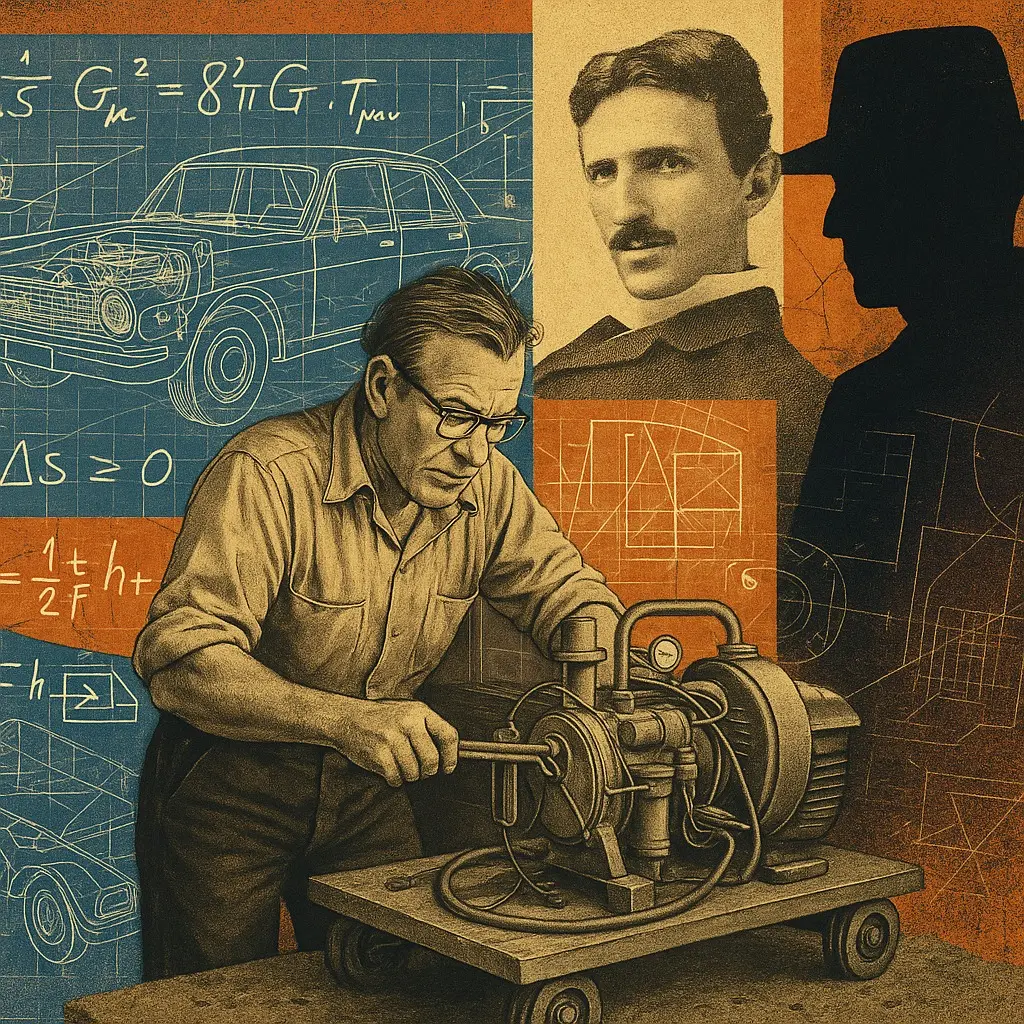
Somewhere in a dusty garage, a lone inventor cracks the code: a carburettor that sips a teaspoon of gasoline, a device that makes cancer implode, a tower that beams power through the ground. The prototype works beautifully — until shadowy men in slim-cut suits yank the plug, bury the evidence, and destroy the lab.
You’ve seen versions of this myth everywhere: Facebook feeds, YouTube documentaries, Reddit conspiracies, late-night conversations that start with “Look, all I’m saying is…”
The promise is intoxicating. These inventions could have rewritten the century — if only they hadn’t been “suppressed.”
Except: that’s not usually how technology dies.
Let’s pull apart a century of alleged miracle machines, look at the physics (and business incentives) they run into, and examine why conspiracy thinking blooms exactly where trust erodes.
The Pattern
A claim goes viral that sounds something like:
- Free, clean, abundant energy
- Cure cancer without chemo
- Defy gravity or entropy
- Power your car with tap water
- Disrupt decade-old monopolies
Then:
- Inventor demonstrates prototype under ideal conditions
- Attracts local media
- Gains believers
- Fails independent replication
- Collides with safety, liability, or thermodynamics
- Dies quietly
That’s when folklore takes over.
“The invention worked too well,” we’re told. “They had to kill it.”
Occam’s razor suggests something else: prototypes are easy; scaling is a war of attrition.
Tom Ogle’s 100-mpg carburettor
In 1977, a 24-year-old Texan modified a Ford Galaxie to drive 100 miles on a single gallon. Journalists rode along; mileage numbers impressed. He patented a “vapor fuel system” that atomized gasoline far more finely than standard carburettors.
Onlookers assumed Detroit must be terrified.
But engineers still wince reading the patent: extremely lean burn means extremely hot combustion. Valve seats erode. Pistons crack. You can reproduce the efficiency — once. Maybe twice. Then the engine dies.
Independent replication failed. Metallurgy science hasn’t changed.
Ogle died at 24. Conspiracies bloomed in the vacuum.
“Lean burn is real,” says one automotive engineer. “But lean enough to triple mileage is lean enough to melt pistons.”
Status: Mechanically self-destructive. Not suppressed; simply not survivable.
Stanley Meyer’s Water Fuel Cell
The most viral clip shows Meyer driving a dune buggy on tap water. He claimed his cell split water into hydrogen and oxygen using a trivial amount of energy. Investors wrote checks.
In 1996, a UK investment group funded independent testing. It found the device performed no better than standard electrolysis.
Water isn’t “fuel.” It’s ash — the burnt remains of hydrogen.
Splitting it takes more energy than you get back.
Courts ruled Meyer’s claims fraudulent. He died shortly after — an aneurysm, medically boring, narratively useful.
TikTok still resurrects him twice a week.
Status: Violates conservation of energy. If real, global grids would already use it.
Royal Rife’s Frequency Cure
Before MRIs and fluorescent proteins, Rife built a microscope able to illuminate living bacteria using unusual optics. That part was impressive.
Then he claimed every pathogen and cancer cell had a “mortal oscillatory rate.” Tune a beam to that frequency, and cells would shatter.
Patients told miraculous stories. But oncology isn’t resonant crystalware: cancer cells are genetically wild west cousins of your own tissues. They don’t share a single resonance frequency. Any field strong enough to rupture malignant cells would also fry healthy ones.
FDA agents seized Rife instruments not to save Big Pharma profits, but to stop unproven medical practice.
Status: Beautiful optics; biologically impossible cure claims.
Tesla’s Wardenclyffe Tower
Nikola Tesla imagined a network of towers transmitting power wirelessly across the globe. Investor J.P. Morgan funded early construction in Shoreham, New York. Tesla changed scope midstream (“free power for everyone!”). Morgan balked — because you can’t meter it.
Wardenclyffe was never completed, never properly energized, and was dismantled for scrap.
Wireless power is real — at centimeters. Efficiency collapses with distance. Air is a terrible conductor.
Status: Brilliant dream; physics and economics disagreed.
Wilhelm Reich’s Orgone Energy
Reich described a universal life force — “orgone” — and built metal-lined boxes to concentrate it. He treated cancer patients and tried to induce rain using his “cloudbuster.” Patients reported good outcomes; clinical trials remained conspicuously absent.
No instrument has ever detected orgone. No effect replicates under blinded conditions.
The FDA destroyed his devices and wrote the least fun legal memo in human history.
Status: Physically unobservable. Regulatory overreaction fed the legend.
Cold Fusion
1989: Chemists Fleischmann and Pons held a press conference (scientists hate press conferences) announcing nuclear fusion at room temperature. The scientific world panicked — then tried to replicate. Most labs saw nothing unusual. Some saw minor heat anomalies attributable to measurement error.
Fusion requires overcoming the Coulomb barrier, the electrostatic repulsion between nuclei. Room temperature conditions don’t come close.
LENR (“low-energy nuclear reactions”) researchers still chase anomalies, but nothing has produced usable power in 35 years.
Status: Original claim collapsed under replication. Fringe research persists.
The Avrocar, Aerowagon, X-Jet, Hendershot, Moray devices, and the physics of disappointment
Many miracle inventions weren’t fake — just fragile:
- Avrocar: Hovered well; became unstable above ground effect.
- Aerowagon: Propeller-driven railcar; derailed at speed.
- Williams X-Jet: One-pilot turbofan platform; worse than helicopters.
- Moray Radiant Device: Never successfully replicated.
- Hendershot Generator: Free energy claim never validated.
These aren’t conspiracies. They’re engineering.
“It worked in the demo” is the easiest possible milestone.
Why the myth persists
The suppressed-invention narrative appears wherever trust breaks down.
- Energy feels expensive and unfair.
- Cancer treatment feels brutal.
- Corporations have lied (see: tobacco, opioids, leaded petrol).
- Governments have buried research (see: MKUltra).
- Hero-inventors are American folklore.
When institutions fail to explain themselves, rumor rushes to fill the vacuum.
Scaling Is Where Prototypes Go to Die
To survive, tech must:
- run for 10,000 hours continuously
- pass insurance underwriting
- meet emission standards
- survive vibration, dust, heat, cold, humidity
- endure idiot misuse
- not burn down garages
- withstand lawsuits
Physics is easy compared to product liability.
The Physics Wall (and why nothing tunnels through it)
Conservation of Energy
You don’t get free lunches. Every energy-in, energy-out device ever built obeys this perfectly. If it didn’t, smartphones would never need charging.
Second Law of Thermodynamics
Entropy always increases. Perpetual motion is illegal — not by law, but by reality.
Faradaic Efficiency / Overpotential
Electrolysis wastes energy as heat. Tap water makes it worse due to dissolved ions.
Coulomb Barrier
Fusion requires massive pressure/temperature. That’s why stars fuse nuclei — and your countertop does not.
Cancer Heterogeneity
No single frequency kills all malignant cell lines.
“I’m sorry, but nothing in biophysics even rhymes with that,” says one oncologist.
Comparison Table
| Claim | Pain Point | Science Verdict | Why It Failed |
|---|---|---|---|
| Water Fuel Cell | Fuel Cost | Violates energy conservation | Fraud ruling; no replication |
| Ogle Carburettor | Efficiency | Mechanically destructive | Real-world engine wear |
| Rife Frequencies | Cancer | Cannot selectively target cells | No clinical trials |
| Cold Fusion | Energy | Not reproducible | Measurement errors |
| Orgone | Life Force | Unmeasured | Unverifiable |
Modern Echoes: LK-99, Graphene, Theranos, Nikola
Our century has its own miracle hype:
LK-99 (2023)
A viral claim of room-temperature superconductivity. Social media frenzy. Labs tested it globally within weeks. Result: nope.
The internet’s memetic immune system worked.
Graphene
A wonder material that turned into ten years of “coming soon.”
Nikola Motors
Footage of a hydrogen truck “driving” downhill. Gravity wins again.
Theranos
Medical miracle claims colliding with regulatory reality.
Same story. Different decade.
Why Fraud Loves Energy Claims
- Energy devices are hard to audit
- Small measurement errors look miraculous
- Joules are invisible
- Humans are terrible at intuition about efficiency
Supply Chain Reality
Even if a miracle device worked:
- Where do you source exotic catalysts?
- Who certifies hydrogen safety?
- Who insures the batteries?
- Who handles end-of-life waste?
The Industrial Commodity System is the real boss battle.
Liability Law
In product law, “reasonably foreseeable misuse” must not cause catastrophe.
That’s why DIY jetpacks aren’t legal for Costco.
Any cancer cure must survive:
- randomized trials
- meta-analysis
- insurance reimbursement
- malpractice litigation
Anecdotes don’t survive cross-examination.
Policy Incentives
Governments don’t suppress clean power. They beg for it. Energy security wins elections.
In 2024, the EU threw subsidies at:
- solar
- heat pumps
- grid batteries
- SMRs
- fusors
If water fuel worked, Brussels would be on your porch with €5 billion.
The Culture Layer
Suppression myths thrive at the intersection of:
- loneliness
- alienation
- medical trauma
- energy anxiety
- institutional distrust
They offer comfort: it’s not entropy — it’s a conspiracy.
That’s psychologically easier.
TikTok and Overunity Culture
Today’s miracle claims run on short-form video:
- LEDs powered by “ambient energy”
- magnets arranged in circles spinning forever
- “quantum heater coils”
- water-car hacks
Comment sections become epistemic echo chambers.
The memetic half-life of bad physics is long.
How to Read a Miracle Claim
- Is there independent replication?
- Are inputs and outputs metered in a sealed loop?
- Does it violate basic physics?
- Are patents used instead of data?
- Is the inventor allergic to third-party tests?
- Does the demo involve hidden wires, hoses, or batteries?
- Does the claim solve a trillion-dollar problem alone?
- Are testimonials replacing clinical evidence?
If yes: don’t mortgage the house.
What Actually Does Work
Miracles exist — they just look boring:
- catalytic converters (cope with quantum chemistry)
- modern insulin analogues
- CRISPR
- mRNA vaccines
- solid-state batteries
- ITER’s Q>1 fusion attempt
- high-temperature superconductors (context matters)
Breakthroughs arrive slowly, then flood.
The Governance Question
Who decides when experimental medicine stops being quirky and starts being negligent?
Regulators aren’t villains. They’re the people who read autopsy reports.
Safety is the most underrated innovation.
The Near Future: Where Real Weirdness Lives
Just because the old miracles don’t work doesn’t mean we’re done.
Metamaterials
Manipulate light and sound in strange ways.
Quantum Batteries
Exploit entanglement for faster charging.
Casimir Effect Research
Vacuum energy remains poorly understood — but not easily harvestable.
Small Modular Reactors
Safer fission modules.
Muon-catalyzed fusion
Weird, promising, still impractical.
Proton-boron fusion
Clean ash. Brutal engineering challenges.
This is the frontier. It’s hard, expensive, slow — and real.
When Technology Was Suppressed
Sometimes the conspiracy theorists get a point:
- Leaded petrol
- Nicotine safety science
- The early solar market (tariffs, underinvestment)
- Diesel emissions cheating (Volkswagen)
- Conglomerates lobbying against early renewables
But these weren’t lone geniuses. They were systemic rot.
The “If X Worked, Then Y” Test
Ask:
- If water cars worked, why not run power plants on them?
- If orgone cured cancer, why not treat lab mice?
- If cold fusion worked, why do startups still buy tokamaks?
Reasoning forward breaks the spell.
Independent Replication Is the Only Winner
Readers know the rule:
If it can’t be reproduced, it doesn’t exist.
Peer review moves slowly.
Crowd review moves fast — and loud.
Replication kills hype.
The Tragedy of the Longshot Inventor
Most aren’t villains. They’re:
- lonely
- underfunded
- desperate
- emotionally entangled with their prototype
When physics disagrees, it feels personal. But nature isn’t negotiating. It’s just… nature.
Engineering Is the Art of Saying No to Entropy
Prototypes are promises.
Products are compromises.
Physics is a tax collector.
So Why Do We Still Believe?
Because miracle machines:
- promise agency
- offer revenge against elites
- soothe climate dread
- shortcut medical fear
In an era of mistrust, suppressed technology is a moral fable.
The Internet’s Memetic Immune System
2023’s LK-99 saga was a turning point.
A claim emerged: room-temperature superconductivity. Within three weeks, dozens of labs live-streamed replication attempts, posted negative results, and dissected sample impurities on GitHub.
The internet didn’t burn the witch.
It ran the experiment.
This is how enlightenment scales.
We’re Getting Better at Not Being Fooled
- Open lab notebooks
- Real-time replication
- Journal preprints
- Data transparency
- Citizen physicists
- Physics TikTok roast squads
The future of science is adversarial collaboration.
The Final Truth
If a device can change civilization:
- venture capital will swarm
- DARPA will call
- CERN will sniff it
- AI researchers will model it
- overseas labs will replicate it
- open-source hackers will clone it
Suppression is impossible in the age of livestreams.
The Real Conspiracy
It’s not Big Oil.
It’s not the AMA.
It’s something colder:
The universe doesn’t care.
Entropy rises. Engines waste heat. Cancer mutates. Efficiency plateaus. And physics, unaffected by petitions, marches on.
That’s not a plot.
That’s thermodynamics.
But we’re getting better at fighting back — inch by inch, volt by volt, Joule by Joule.
Progress is slower than myth.
But it actually works.