


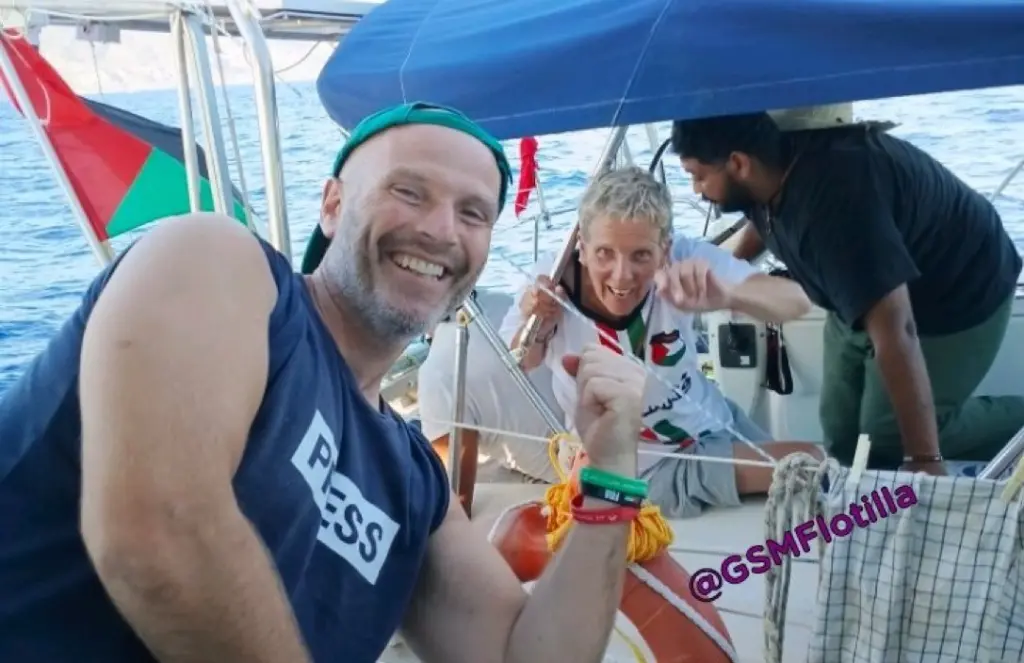
British activist and journalist Sarah Wilkinson was detained by UK police at Heathrow Airport on Sunday following her deportation from Israel, after taking part in the Global Sumud Flotilla, a humanitarian mission attempting to deliver aid to Gaza.
Her detention comes amid an escalating clampdown on Gaza-solidarity activists and journalists in Britain, with the UK’s Terrorism Act 2000 increasingly used against those accused of “supporting proscribed groups.”
Wilkinson, 62, from Bishop’s Castle, Shropshire, has been charged with five terrorism offences for allegedly supporting Hamas, including offences of support, encouragement, dissemination, and failing to provide device passwords under a RIPA notice, and is now due to appear at Westminster Magistrates’ Court on 20 October.
In August 2024, Wilkinson’s home was raided in a dawn operation by masked counter-terrorism officers, who cited her online content as justification for the search and arrest. She later described the experience as terrifying, saying police burst through her door as though carrying out a military assault. Officers reportedly searched her property, confiscated devices, and detained her for questioning before imposing strict bail conditions.
Wilkinson’s participation in the flotilla had reportedly been approved by police prior to departure. Yet while she was aboard the mission’s vessel in international waters, her bail conditions were allegedly amended without her knowledge—adding a ban on overseas travel that automatically rendered her voyage a breach of those terms.
“A Moral Obligation to Act”
Supporters say Wilkinson’s involvement in the Sumud Flotilla was driven by humanitarian duty, not political allegiance. The conditions in Gaza, they argue, are so catastrophic that direct civilian action has become a moral necessity.
Now entering its third year, Israel’s assault on Gaza has been described by UN experts as “the total destruction of a civilian population.” More than 67,000 Palestinians have been killed—20,000 of them children—and 168,000 injured. Over 436,000 homes, about 92 percent of all housing, have been damaged or destroyed, and 2.1 million people, roughly 95 percent of Gaza’s population, have been displaced.
Only 14 of Gaza’s 36 hospitals remain partly operational, with 1,700 medical staff killed. Famine was officially declared in August 2025 after months of blockade, with 400 deaths linked to malnutrition, including over 100 children.
Before departing on the flotilla, Wilkinson said her decision stemmed from conscience: “We are watching a genocide unfold in real time, and our governments are complicit. Going to Gaza wasn’t politics—it was humanity.”
From the Mediterranean to Heathrow
Following the interception of the Sumud Flotilla by Israeli naval forces in international waters, Wilkinson and other participants were detained and transferred to Israeli custody. She later described being held in harsh conditions—deprived of sleep, moved between cells multiple times, and subjected to intimidation and psychological pressure by Israeli authorities.
“It was a whole bag of crimes against humanity,” she said after her release. “They kept the lights on all night, denied us proper food or sleep, and laughed when we asked for water. I was questioned for being human.”
After several days in custody, Wilkinson and other foreign nationals were deported from Israel to Turkey, flown from Tel Aviv to Istanbul aboard a Turkish aircraft arranged for the release of flotilla participants. “The Turkish people treated us with humanity,” she recalled. “They fed us, clothed us, and gave us a bed. It felt like rescue after days in darkness.”
Wilkinson then flew from Istanbul to London Heathrow, where she was detained by UK police under the Terrorism Act upon disembarking on Sunday.
A Failure of Duty and Diplomacy
International-law specialists say the Sumud Flotilla raid was not only illegal but an act of aggression against the sovereign nations whose flags those ships flew—including the United Kingdom.
Former British diplomat Craig Murray described Israel’s actions as “an act of war” against every flag state represented in the flotilla. “There’s no right to intercept vessels on the high seas,” Murray said. “When you’re on the high seas, the law that applies is the law of the state whose flag the vessel flies. So an attack by a military ship on that vessel is legally an attack on that flag state.”
The flotilla—around forty civilian vessels flying British, Irish, Norwegian, Turkish, and Canadian flags—was sailing in international waters when it was surrounded, boarded, and seized by the Israeli Navy. Communications were jammed, distress frequencies blocked, and civilian aid workers forcibly abducted. Those taken from the flotilla were transported to Israeli prisons, where they were detained before eventual deportation.
Legal experts say the simultaneous seizure of ships from multiple sovereign nations on the high seas is virtually without precedent in modern history, constituting a collective violation of maritime sovereignty and international law.
Despite this, the UK government and Foreign Office appear to have made no protest, issued no diplomatic note, and taken no steps to assist the British citizens or the British-flagged vessels involved. No condemnation was issued, and no parliamentary statement was made.
Instead, the first official action taken toward Wilkinson and other British participants came only when they reached home—in the form of police detention under anti-terror laws.
“This is the inversion of justice,” Murray said. “Britain did nothing when its citizens were abducted in international waters—but arrested them when they came home. It’s a betrayal of sovereignty and of the most basic duty a state owes its people.”
Under both the United Nations Convention on the Law of the Sea (UNCLOS) and the San Remo Manual, an attack on a ship in international waters constitutes an attack on the flag state’s jurisdiction. By failing to respond, the UK effectively allowed an assault on its own citizens and vessels to go unanswered.
Arrests Ripple Across the UK
Wilkinson’s case is part of a broader pattern of repression targeting pro-Palestine journalists and campaigners under counter-terrorism legislation.
In July 2024, British-Syrian journalist Richard Medhurst was questioned under the Terrorism Act at Heathrow Airport after returning from a conference on Gaza reconstruction in Europe.
Earlier this year, Asa Winstanley, an investigative journalist with The Electronic Intifada, had his London home raided by counter-terrorism officers under the same law. His devices were seized, though he was not arrested or charged. A senior judge later ruled that the warrants used in the raid were unlawful.
Press-freedom organizations condemned both cases as “a dangerous precedent for the criminalization of journalism.”
Allegations of Lobby Influence
Civil-rights lawyers say these cases expose the growing political influence of pro-Israel lobbying networks in British policing.
Observers have pointed to the possible involvement of UK Lawyers for Israel (UKLFI)—a lobby group known for pressuring institutions and media outlets to cut ties with Palestinian advocacy organizations. Several activists and journalists also believe the Israeli Embassy in London has played an informal but active role in encouraging UK authorities to apply the Terrorism Act to pro-Palestine figures.
While direct evidence has yet to emerge, both the embassy and UKLFI have a documented history of lobbying for expanded proscription measures, including the UK’s 2019 ban on all wings of Hezbollah.
“It’s increasingly clear that foreign-policy interests are shaping domestic policing,” said one civil-liberties lawyer familiar with Wilkinson’s case. “When humanitarianism and journalism are treated as terrorism, democracy itself is endangered.”
The Global Sumud Flotilla
The Sumud Flotilla—named after the Arabic word for steadfastness—brought together activists, medics, and journalists from more than forty countries, attempting to break Israel’s blockade of Gaza with food and medical supplies.
“The mission was simple,” Wilkinson explained. “We were bringing food, medicine, and dignity to people the world has abandoned.”
Organizers said the flotilla symbolized an act of global civilian resistance to Israel’s eighteen-year siege of Gaza, which has left the enclave on the brink of total collapse. Though intercepted at sea by Israeli forces, its participants sought to uphold what they called “the legal and moral duty to prevent genocide.”
The Criminalization of Compassion
Human-rights organizations have condemned the UK’s handling of Wilkinson’s case as part of a wider campaign to suppress solidarity with Gaza. Reporters Without Borders called the use of terrorism laws against journalists and aid workers “an assault on press freedom.” Amnesty International warned that the practice risks criminalizing legitimate humanitarian activity and dissent.
The UK Home Office insists that counter-terrorism laws are applied impartially to prevent support for banned groups. But critics say those laws are being stretched to target political speech and humanitarian efforts connected to Palestine.
“We are witnessing the criminalization of compassion,” said one solicitor involved in Wilkinson’s defense. “People trying to alleviate human suffering are being treated as national-security threats.”
For many observers, the contrast is staggering: a British journalist abducted by a foreign military on the high seas—then detained by her own government on return.
As Gaza’s destruction deepens, the arrest of Sarah Wilkinson, the questioning of Richard Medhurst, and the raid on Asa Winstanley’s home have come to symbolize a turning point in Britain’s approach to dissent. Whether these actions represent a legitimate defense against extremism—or a politically driven campaign to silence solidarity—may define the boundaries of free expression in the United Kingdom for years to come.