


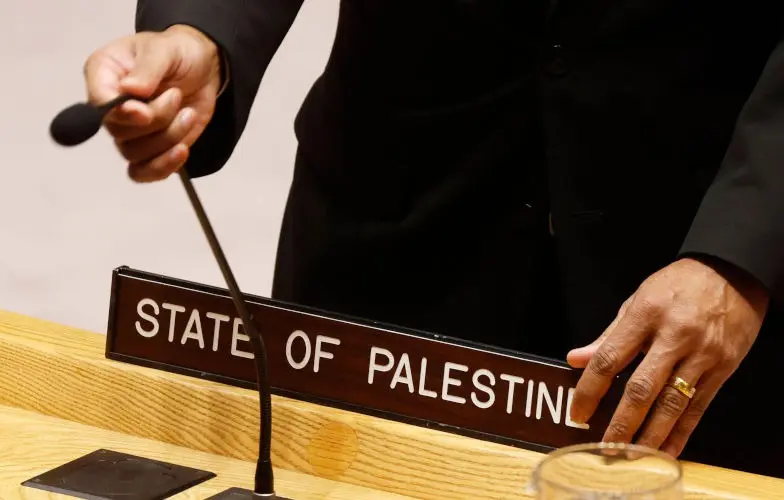
The campaign for global recognition of a Palestinian state has reached a turning point. For the first time, major Western powers — including France, the United Kingdom, Canada, Australia, Portugal and Belgium — have pledged to formally recognise Palestine at the United Nations General Assembly in New York, during a high-level summit on September 22, 2025, co-chaired by France and Saudi Arabia.
Their announcements follow a dramatic wave of recognitions in the past 18 months, with countries from Norway and Ireland (May 22, 2024) to Mexico (March 2025) and several Caribbean states (2024) adding their support.
This marks a historic break from decades of hesitation in the West, where recognition was long confined to symbolic parliamentary motions and rhetorical support. France’s July 2025 declaration was especially significant, making it the first G7 country to commit to recognition. The move spurred others: the UK and Canada (July 2025) swiftly followed, with Australia (August 2025), Belgium (September 2025), Portugal (September 20, 2025), Luxembourg and Malta (July 2025) joining the chorus. New Zealand has said it is considering recognition before the end of the year.
Yet the shift remains divisive. Germany and Italy have refused to follow suit, while the United States and Israel remain firmly opposed, branding recognition “reckless” and a reward for Hamas. Israeli ministers have threatened to expand settlement construction in retaliation.
Grassroots Pressure Inside Israel
In a striking development, opposition to Israel’s government line is also coming from within. Close to 9,000 Israelis have signed a petition calling on the world to recognise a Palestinian state ahead of the September 22 UN summit in New York.
The petition — entitled “No to war, yes to recognition!” — was organised by Zazim – Community Action, a grassroots movement of Jews and Arabs advocating democracy and equality. Backed by bereaved families of October 7 victims, the petition declares:
“We are citizens of Israel who are opposed to continuing the war in Gaza and believe in peace. We call on the nations of the world to recognise Palestine during the United Nations General Assembly.”
As of September 19, it had gathered 8,866 signatures, with organisers aiming for 10,000 to present at the UN. Raluca Ganea, Zazim’s co-founder, said the initiative sought to show the world that “a large part of Israeli society understands that recognition of a Palestinian state is also in Israel’s interest.”
The campaign explicitly contrasts ordinary Israelis’ support for recognition with the government’s hard line. It also highlights internal divisions: Prime Minister Netanyahu has warned that Israel faces a “Spartan path” of eternal war, while petition organisers argue that “a political solution with two states for two peoples, each with sovereignty, security and peace, is the only alternative on the table.”
What Recognition of Palestine Actually Means
When a country “recognises” the State of Palestine, it is making a formal diplomatic act under international law. This can take several forms:
- Unilateral recognition: A government issues an official statement or decree recognising Palestine as a sovereign state.
- Bilateral ties: Countries may establish diplomatic relations, open embassies, or accredit ambassadors.
- Multilateral support: Recognition can include supporting Palestine’s admission to international organisations such as the UN or the International Criminal Court.
How It Works
Recognition is usually immediate once declared, though building full diplomatic relations can take months or years. Records are kept in official government documents and by the United Nations Secretariat, while Palestine’s Ministry of Foreign Affairs tracks recognitions globally.
What Palestinians Gain
Recognition strengthens Palestine’s claim to sovereignty and offers practical benefits:
- Diplomatic legitimacy: Palestine is treated as a state in bilateral and multilateral forums.
- Embassies: Diplomatic missions can be upgraded to embassies, with ambassadors enjoying state-to-state status.
- International standing: It bolsters Palestine’s campaign for full UN membership, long blocked by US vetoes.
- Legal rights: It improves Palestine’s ability to sign treaties, pursue cases at the ICC, and claim control over its resources.
The Territory
Most recognitions define Palestine as comprising the West Bank (including East Jerusalem) and Gaza Strip, based on pre-1967 borders. This covers about 22% of historic Palestine, with East Jerusalem as the intended capital.
- Settlers: Around 700,000 Israeli settlers live in the West Bank and East Jerusalem. Recognition does not automatically remove them, but many countries consider the settlements illegal and expect eventual withdrawal, land swaps, or compensation.
Sovereignty in Practice
Recognition affirms Palestine’s right to:
- Security forces: In principle, to maintain an army. Currently limited by the Oslo Accords, this would be a major point of contention.
- Borders and airspace: To operate its own airports and seaports. Today, Israel controls all crossings and airspace.
- Natural resources: To exploit resources such as offshore gas fields near Gaza. Recognition could strengthen its standing in negotiations over these reserves.
The Limits
Recognition does not change realities on the ground overnight. Israel still controls much of the West Bank and the Gaza blockade. But recognition increases Israel’s isolation and strengthens Palestine’s legal and political position.
Historical Context: A Long Struggle for Recognition
When Yasser Arafat proclaimed Palestinian independence in Algiers in 1988, more than 80 countries — mainly in the Global South, Africa, Asia and Latin America — immediately extended recognition. A UN General Assembly resolution that December effectively acknowledged the proclamation, with 104 countries voting in favour.
By the mid-1990s, the Arab League, most of Africa, and large swathes of Asia had endorsed Palestinian statehood. By 2011, every African state except Eritrea and Cameroon had recognised.
Latin America surged in the early 2010s, when Brazil, Argentina, Bolivia, Ecuador and Uruguay led a wave of recognitions. In Europe, progress was slower: Sweden became the first Western European state to officially recognise Palestine in 2014, and the UK Parliament the same year passed a non-binding motion urging recognition.
As of 2024, roughly 146 of the UN’s 193 members recognised Palestine. That number has continued to climb with recognitions from Armenia (2024), the Bahamas (2024), Jamaica (2024), Trinidad and Tobago (2024), Barbados (2024), and Mexico (2025), alongside the landmark pledges from Western capitals in 2025.
Europe: A Shift at the Core
Europe’s role is pivotal in 2025.
- Norway, Ireland and Spain recognised on May 22, 2024.
- Slovenia followed on June 4, 2024.
- France pledged recognition on July 18, 2025, becoming the first G7 state to do so.
- The UK and Canada announced recognition on July 30, 2025, conditional on Palestinian reforms.
- Malta and Luxembourg signaled intent in July 2025.
- Australia declared recognition on August 14, 2025.
- Belgium confirmed recognition in early September 2025.
- Portugal formally joined on September 20, 2025.
The European Parliament in September 2025 passed a resolution urging member states to follow. Yet Germany and Italy remain opposed.
The Americas: From Pioneers to Newcomers
In Latin America, recognition has been widespread since 2010–2011. By 2023, 17 of 19 sovereign states in the region had recognised.
In March 2025, Mexico formally joined them. In the Caribbean, the Bahamas, Jamaica, Trinidad and Tobago, and Barbados all recognised in 2024.
In North America, the United States remains opposed. Canada’s July 2025 shift marks the first break with Washington’s stance.
Asia and Oceania: Longstanding Support, New Moves
Many Asian nations recognised Palestine in 1988, including China, India and Indonesia.
Recent moves include Armenia (2024) and Australia (August 2025). New Zealand is reviewing its position.
Japan, South Korea and Singapore remain opposed.
Africa: A Unified Front
By 2011, every African country except Eritrea and Cameroon had recognised Palestine. The African Union continues to support Palestinian statehood, with South Africa a leading advocate.
Arab World: Foundational Recognition
All 22 members of the Arab League recognise Palestine. At a summit in late 2024, Arab and Islamic leaders commended states that had recognised Palestine and urged others to follow suit.
Symbolic and Parliamentary Actions
Parliaments have played a role where governments hesitated. The UK Parliament’s 2014 vote passed overwhelmingly but was non-binding. In September 2025, the European Parliament urged EU states to recognise. In Australia, a 2024 parliamentary motion failed, but the government later changed course.
Opposition and Reversals
The United States, Germany, Italy, Japan and South Korea remain opposed. Israel has recalled ambassadors, threatened settlement expansion, and accused Western states of “rewarding terrorism.”
No country has rescinded recognition, though in Australia the opposition has vowed to revoke it if returned to power.
Recognition vs. Enforcement: The Reality Check
Recognition gives Palestine powerful legal standing, but enforcement remains the challenge.
- International law: Recognition strengthens Palestine’s ability to bring cases to the ICJ and ICC, claim rights under the Geneva and Genocide Conventions, and demand restitution of land and property.
- Diplomatic tools: Recognising states can impose sanctions, ban settlement products, and support Palestine in global trade and finance.
- Economic sovereignty: Recognition bolsters claims to borders, airports, seaports, and offshore gas fields.
But without enforcement, these rights are largely aspirational. Israel has repeatedly ignored international rulings, from the ICJ’s 2004 opinion on the West Bank wall to the 2024 ruling declaring the occupation unlawful.
Who Could Help Enforce?
- United Nations: Symbolic backing through the General Assembly, but US vetoes cripple enforcement at the Security Council.
- Courts: ICJ and ICC can issue rulings and warrants, but rely on states to act.
- States and blocs: Arab League, African Union, and EU countries could pressure Israel through sanctions or embargoes.
- Civil society: Boycotts, divestments, and sanctions (BDS) movements gain new legitimacy with state recognition.
What Palestinians May Actually Gain
- More embassies and treaties.
- Stronger cases at international courts.
- Diplomatic isolation of Israel.
- Symbolic affirmation of sovereignty.
The Hard Reality
On-the-ground sovereignty — controlling borders, removing settlers, operating airports, exploiting natural resources, or raising an army — will depend not on recognition alone, but on whether powerful states or coalitions are willing to confront Israel.
A Global Majority
By September 2025, more than 150 states are expected to formally recognise Palestine. While recognition does not instantly change realities on the ground, it strengthens Palestine’s diplomatic hand and underscores Israel’s growing isolation.
Even within Israel, the Zazim petition shows that ordinary citizens are pressing for change, framing recognition not as a threat but as the only viable path to peace.
As the UN General Assembly convenes on September 22, 2025, one question looms: will the final holdouts in the West continue to resist, or accept that a two-state solution requires two states?
📌 Recognition of Palestine: What It Means (and Doesn’t)
What It Gives Palestinians
- ✅ Statehood legitimacy – treated as a sovereign state in diplomacy and law.
- ✅ Embassies & treaties – upgrade of missions to full embassies, ability to sign international treaties.
- ✅ International legal power – stronger standing at the UN, ICJ, and ICC to challenge occupation and settlements.
- ✅ Economic rights – claims to borders, airspace, and natural resources, including Gaza’s offshore gas fields.
- ✅ Symbolic victory – isolates Israel diplomatically, affirms global majority support.
What It Does Not Guarantee
- ❌ Territorial control – Israel still controls borders, airspace, and settlements.
- ❌ End of occupation – settlers and military presence remain until enforced or negotiated.
- ❌ Immediate sovereignty – airports, seaports, and army still restricted under Israeli blockade and Oslo framework.
- ❌ Enforcement – depends on international will; Israel has ignored past UN and ICJ rulings.