


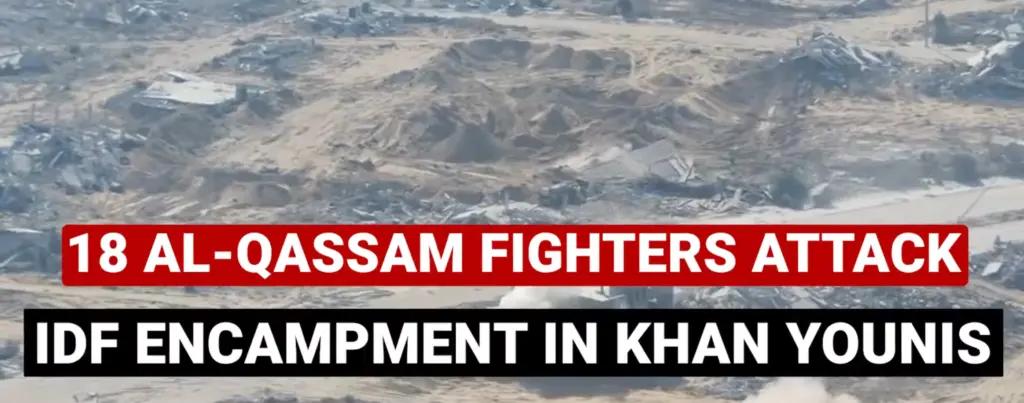
On July 9, 2025, a single attack east of Khan Younis sent shockwaves through Israel’s political and military establishment. Palestinian resistance fighters launched a daring ambush against what Israel regarded as one of its safest bases inside Gaza, killing at least one soldier, seizing weapons, and retreating through a tunnel under the stunned gaze of the Israeli army.
The attack was not only a tactical strike — it was a devastating blow to Israel’s claim that it had “defeated Hamas” in Khan Younis, a city it has ethnically cleansed and flattened in violation of international law.
The ambush and the death of Azulay
Initial reports centered on Master Sgt. (res.) Abraham (Avraham) Azulay, 25, an IDF engineering vehicle operator killed during the operation. Hamas fighters struck an excavator with an RPG, forcing Azulay to flee before he was gunned down at close range. His weapon was seized, and his death filmed in detail.
The Al-Qassam Brigades admitted they had attempted to capture him alive. “Field conditions prevented us from doing so,” they said, “so we killed the soldier and seized his weapon.” The footage released on July 10 confirmed this.
The IDF, however, spun a different story — that Hamas fighters emerged from a tunnel, tried to abduct Azulay, and that he heroically “struggled” before being shot. Israeli reinforcements, they said, killed several attackers. But the video released by Hamas contradicted this: no tunnel emergence, no hand-to-hand struggle, no Israeli rescue. Instead, it showed a swift and humiliating ambush.
A base, not just a bulldozer
As more information emerged, it became clear the attack was far more serious than Israel initially admitted. Resistance fighters had struck at a command base east of Khan Younis, penetrating what Israel had considered a secure zone.
Livestream reports and leaked unedited footage circulating inside Israel showed something extraordinary: 8 fighters calmly withdrawing back into a tunnel, carrying weapons, unhurried, without IDF fire striking them. Israel had released its own heavily edited clips showing two fighters being run over by a tank and others struck from the air — but the leaked footage made clear this was propaganda. Many fighters escaped unharmed.
Israeli analysts began asking uncomfortable questions:
- If the IDF knew about the tunnel, why did it not seal the exit?
- How did resistance fighters infiltrate a base where Israeli soldiers were sleeping?
- Why did the IDF claim “the majority” of fighters were killed when leaked footage showed otherwise?
The answers pointed to either staggering incompetence or deliberate deception. Either way, the operation left Israel reeling.
Echoes of October 7
Inside Israel, commentators described the attack as “another October 7.” Just as on that day in 2023, heavily armed resistance fighters emerged from tunnels and destroyed the illusion of Israeli security. Despite two years of siege, bombardment, and genocide in Gaza, the resistance demonstrated that it could strike behind Israeli lines at will.
This was not an isolated incident. On July 8, Hamas staged another lethal ambush in Beit Hanoun, in the north, a town Israel had declared reduced to rubble and “cleared” of fighters. Again, resistance fighters reappeared, carried out attacks, and vanished.
Israel’s claim that 75% of Gaza was “under control” collapsed in real time.
Ethnic cleansing and illegality
The July 9 attack gains greater significance in the context of Israel’s campaign against Khan Younis itself.
On May 19, 2025, the IDF ordered mass evacuations of Khan Younis, Bani Suhaila, and Abasan, telling civilians to flee to the Al-Mawasi coastal strip. It was one of the largest forced transfers of the war. Hospitals reported more than 100 killed in 24 hours during the accompanying bombardment.
This constitutes a grave breach of the Fourth Geneva Convention. Forcible transfer of civilians by an occupying power is a war crime. Israel’s repeated mass expulsions across Gaza amount to ethnic cleansing.
Netanyahu, on that same day, promised to “take control of the whole Strip.” Israel claimed it had “eliminated Hamas” in Khan Younis. But the July ambush shows otherwise: resistance is alive, organized, and capable of striking even in supposedly secured zones.
IDF’s history of lies
Israel has a proven record of hiding its true losses. From underreporting casualties to invoking the Hannibal Directive — using overwhelming fire, even against its own troops, to prevent captures — the IDF routinely manipulates battlefield information.
The July 9 ambush follows this pattern. Hamas produced raw video evidence. Israel responded with censored clips, fabricated heroics, and claims that most attackers were killed. The leaked unedited video inside Israel exposed this as false.
This is why, in reporting this war, Palestinian resistance accounts carry more weight than Israel’s official line.
Political fallout in Israel
The attack sparked turmoil inside Israel. Military commentators, politicians, and even IDF officers acknowledged “massive failure.” One commander from the elite Yahalom engineering unit resigned soon after, citing “personal reasons.” In truth, morale is collapsing.
Prime Minister Netanyahu, caught between demands for victory and rising domestic dissent, wavered. Days after vowing to conquer Gaza entirely, he suddenly authorized new negotiations over hostages, signaling that Hamas’ battlefield pressure was working.
Netanyahu’s government is fracturing. Ministers openly admit they are willing to kill Israeli hostages to prolong the war. Coalition partners are hemorrhaging public support. Polls show Netanyahu weakened but still clinging to power, unable to form a stable coalition without opposition defections.
International implications
The Khan Younis ambush also carried a message beyond Gaza. Israeli media reported that Hamas intended it as a signal to Israel: refuse a ceasefire, and we will reproduce October 7-style operations. The attack underscored that despite Israel’s overwhelming firepower, the resistance can strike in ways that reverberate politically and psychologically far beyond the battlefield.
Meanwhile, Netanyahu lashed out at international critics, even threatening countries like Australia with dire consequences for recognizing Palestine or criticizing Israeli war crimes. His rhetoric grew more erratic as battlefield reality undermined his claims of victory.
The lie exposed
The July 9 ambush in Khan Younis is more than just another skirmish. It is a direct refutation of Israel’s central narrative: that Hamas has been dismantled, that Gaza is under control, that ethnic cleansing can secure “victory.”
The truth is otherwise. Resistance fighters infiltrated a supposedly secure base, killed an Israeli soldier, seized weapons, and withdrew unscathed. Video evidence contradicted Israel’s version. Leaks from within Israel confirmed its deception.
At the same time, Israel continues to ethnically cleanse Khan Younis, displacing tens of thousands in violation of international law. The ambush shows that this policy is not eliminating resistance — it is fueling it.
For Israel, the Khan Younis ambush was an earthquake. For Palestinians, it was proof that even in the face of genocide, armed resistance endures. And for the world, it is yet another reminder that Israel’s war is built on lies — lies about victory, lies about security, and lies about the erasure of a people who refuse to be erased.