


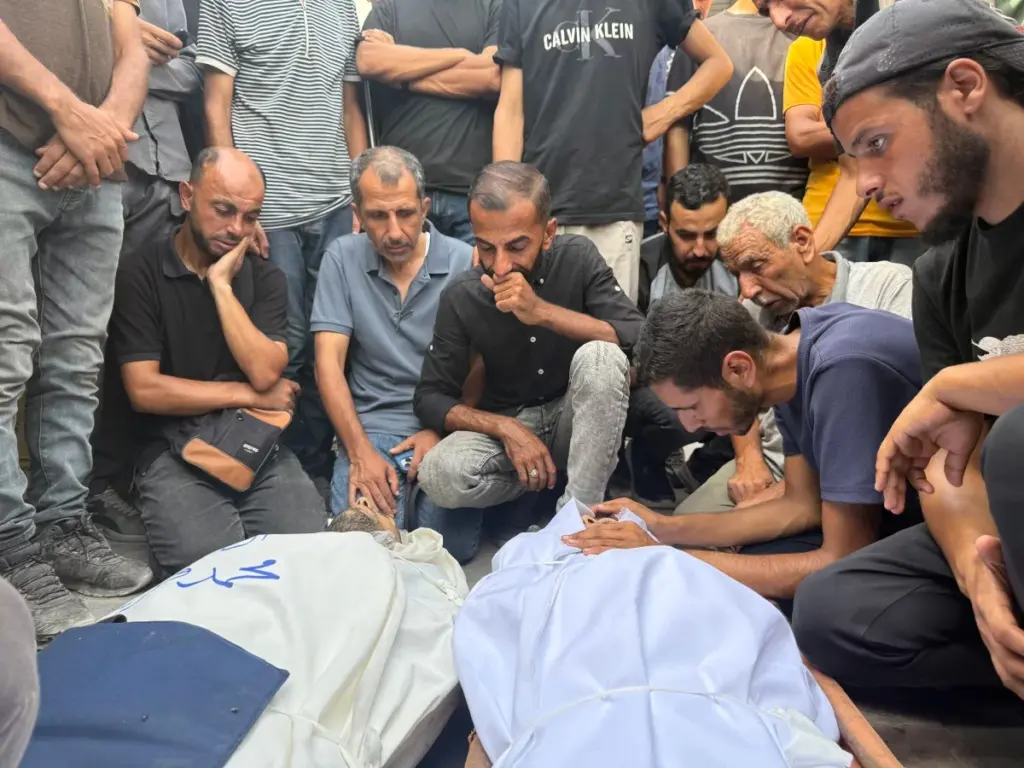
Israel’s targetted murder of Al Jazeera correspondent Anas al-Sharif and four colleagues in Gaza City was a calculated move by the rogue state to remove one of the most visible chroniclers of its genocide before launching a full-scale occupation of Gaza’s remaining population centres.
Palestinian-Dutch analyst and Jadaliyya co-editor Muin Rabbani told journalist Owen Jones that the latest Israeli operation marks an attempt to re-establish direct military control over the last areas outside its physical grip. The Israeli cabinet’s decision targets Gaza City, the central camps, and the al-Mawasi “humanitarian zone,” with the aim of forcing hundreds of thousands of residents south into increasingly unliveable conditions near Rafah.
Rabbani said the objective is to create “social collapse, chaos, and anarchy” so that Palestinians leave “not because of an official decree, but because survival demands it.” Israeli officials openly describe this as “voluntary immigration,” a term Rabbani argues is a euphemism for forced population transfer.
Gaza Under Occupation — Then and Now
Gaza has been under Israeli occupation since 1967, Rabbani noted, and legally so even after the 2005 “disengagement,” because Israel maintained control over land, sea, airspace, borders, and civil infrastructure. The latest military phase follows Operation Gideon’s Chariots earlier this year, which failed to deliver the declared “total victory.”
The new push aims to level what remains of Gaza City and the central refugee camps — Nuseirat, al-Bureij, and al-Maghazi — while displacing civilians southwards. Egypt and other states have rejected permanent resettlement of Gaza’s population in Sinai, but Israel is pursuing a gradual version of that outcome through siege, bombardment, and famine.
Two factors complicate the plan: many northern Gaza residents refuse to abandon their homes, knowing they will never be allowed back, and there is no safe route south — “humanitarian zones” themselves have been repeatedly bombed. Hunger, Rabbani said, is being deployed as a weapon to accelerate displacement.
US Backing and Internal Israeli Fault Lines
Donald Trump’s February endorsement reframed the expulsion plan as an American initiative, Rabbani argued, giving Israel political cover. The Biden administration had tried to sell the idea to Arab states without success.
In Israel, dissent falls into three camps:
- Far-right figures who want an even more extreme campaign.
- Military leaders concerned about overstretching Israel’s small, tech-reliant army and leaving other fronts vulnerable.
- Segments of the public seeking a negotiated end to the war to secure the return of Israeli captives.
Notably, Rabbani said, no one in Israel’s leadership is opposing the plan due to international pressure — reflecting confidence that condemnation abroad will remain rhetorical.
Famine, Propaganda, and the Silencing of Witnesses
The UN-backed IPC confirmed famine is underway in Gaza weeks ago. While Israeli ministers once feared images of starving Palestinians could alienate Western allies, Rabbani said the government has met those risks with propaganda — dismissing emaciated children’s suffering as unrelated to hunger and smearing aid agencies.
Against this backdrop came the killing of Anas al-Sharif. Rabbani said Israel had long had the capability to target him but acted now to remove “one of the most active witnesses to what they’re about to do” in Gaza City.
Al-Sharif, one of Gaza’s best-known journalists, had just warned of an impending invasion and told the world, “Silence is complicity.” He and his colleagues were killed in a tent clearly marked for journalists outside al-Shifa Hospital. Israel immediately claimed responsibility, pairing it with contradictory allegations that he was a Hamas commander — inconsistencies Rabbani said underscore that the aim is not to prove a case, but to sow doubt and deter confident public condemnation.
“They bar foreign journalists, delegitimize Palestinian reporters, and maintain total narrative control,” Rabbani said. “Without Al Jazeera, this would be a much less livestreamed genocide.”
Recognition Without Consequences
Beyond Gaza, Rabbani addressed the wave of Western states recognising Palestine — most recently Australia, with France and Britain considering similar moves. He stressed that recognition is largely symbolic unless paired with concrete measures to confront Israeli policies in Gaza and the West Bank.
“We’re way past the point where recognition alone makes a difference,” he said. “Without using real leverage to end impunity, it risks being empty political theatre.”
West Bank: Gaza’s Mirror in Slow Motion
In the West Bank, Rabbani described “pogrom after pogrom” and the largest forced displacement since 1967, with up to 50,000 Palestinians expelled from northern districts like Jenin and Tubas. He warned that unchecked Israeli actions in Gaza set the precedent for expanding annexation and ethnic cleansing in the West Bank.
“Every action without a reaction lays the basis for a more intense next step,” he said. “Israel pushes until it meets real resistance — and so far, it hasn’t.”