


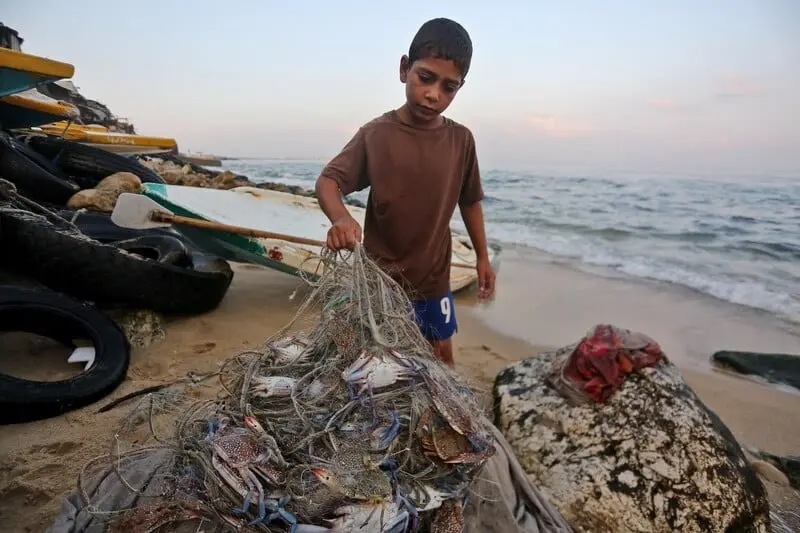
Israel declared the entire Gaza coastline a “no-go zone” this summer, banning all Palestinian access to the sea for fishing, swimming, bathing, or even approaching the shore. The military order, issued in Arabic, warned that anyone entering the water will be treated as a threat and could be shot. The move finalized Israel’s complete enclosure of Gaza—by land, air, and now sea—leaving its population with nowhere left to turn.
Gaza’s Fishermen: Lives Lost, Livelihoods Destroyed
Since October 7, 2023, Israeli forces have killed more than 200 Palestinian fishermen, many of them gunned down at sea. Once a key part of Gaza’s economy and food supply, the fishing industry has collapsed to under 7% of its pre-war capacity. Fishermen now risk death for venturing even meters from shore.
At the start of the war, Israeli Defense Minister Yoav Gallant declared a total siege: “No electricity, no food, no water.” With Gaza’s water systems destroyed, the sea became the only available space for washing and sanitation. That lifeline, too, has now been violently cut off. In October 2023, UK Labour leader Keir Starmer defended the siege, claiming Israel had the “right” to do so—despite the collective punishment of civilians being illegal under international law.
Beneath the Surface: Gaza’s Stolen Gas
Gaza’s sea isn’t just a humanitarian zone—it’s a strategic one. Beneath its waters lies the Gaza Marine gas field, discovered in 2000 and estimated to hold 30 billion cubic meters of natural gas worth $4 billion. Though legally under Palestinian jurisdiction, Israel has blocked its development for decades. In 2023, Israel issued gas exploration licenses in waters overlapping Gaza’s Exclusive Economic Zone (EEZ), in violation of the UN Convention on the Law of the Sea (UNCLOS).
Human rights groups accuse Israel of resource theft under military occupation, using its blockade not only to starve Palestinians but to deny them control over their own natural wealth.
Freedom Flotilla: A Decade of Lawlessness at Sea
Humanitarian activists attempting to reach Gaza have also been met with Israeli violence in international waters:
- 2010 – Mavi Marmara: Israeli commandos killed 10 civilians, including a U.S. citizen, aboard a Turkish-flagged aid ship.
- 2024 – Handala: Israeli forces abducted 21 activists from 12 countries aboard a flotilla ship 40 nautical miles off Gaza. Passengers were shackled, beaten, and deported.
- 2025 – Madleen: A UK-flagged vessel carrying activists—including Greta Thunberg—was intercepted 185 km offshore. Israel used drones and tear gas before seizing the ship and detaining everyone onboard.
No flag state has held Israel accountable. The acts amount to state piracy, committed openly and without consequence.
2014 Gaza Beach Killings: A Pattern of Impunity
This is not new. In July 2014, Israeli missiles killed four children—Mohammad Ramiz Bakr (11), Ahed Atef Bakr (10), Zakariya Ahed Bakr (10), and Ismail Mahmoud Bakr (9)—as they played on a public beach in Gaza. International journalists witnessed the attack. Yet in 2015, Israel cleared itself of wrongdoing, calling the strike a “tragic accident” and claiming the area was a Hamas naval base. No attempt was made to interview journalists who had seen the boys playing. (The Guardian, June 11, 2015)
Israel’s internal investigations are notorious for producing self-exoneration without accountability—a trend that continues today.
Lebanon’s Fishermen Under Fire: The Silent Expansion of Israel’s Sea War
On February 2, 2025, 47-year-old Atef Ahmad Juhair and his cousin Mohammad were compressor diving near Lebanon’s southern maritime border. Two Israeli gunboats entered Lebanese waters. At gunpoint, Israeli soldiers abducted Mohammad and disappeared with him. Atef reported the incident to Lebanese military intelligence—no investigation followed.
In June 2025, Israeli forces abducted another fisherman, Ali Fneish, under nearly identical circumstances. His partner, Abdel Karim Ajami, was beaten and thrown overboard. The attack unfolded in full view of Lebanese army personnel and UN peacekeepers. Again, no one intervened.
The Israeli military has escalated its harassment campaign:
- Drones stalk boats near Naqoura.
- Fishing cooperatives have been bombed.
- Leaflets have threatened lethal force against fishermen.
Fishermen who once filled Naqoura’s docks have fled north to Sour, abandoning richer waters out of fear. Veterans like Ahmad Salim say drone attacks, sonic bombs, and gunfire make it “unbearable” to fish in the south.
“Before going to sea, a fisherman tells his son to take care of his mother. He says goodbye like he’s not coming back.” — Fisherworkers’ syndicate member in Sour
A History of Abuse
From 1978 to 2000, during Israel’s occupation of southern Lebanon, fishermen were regularly detained, tortured, and stripped of their gear. Many were imprisoned in Haifa. Israel’s renewed maritime attacks are seen as a continuation of that policy—aimed at emptying the south of its people and asserting dominance over contested waters.
Even after the 2024 ceasefire between Israel and Hezbollah, the violence continues. Boats have been looted or damaged. Israeli drones drop explosives near vessels or photograph fishermen at close range. Surveillance cameras now monitor Naqoura’s port. Israeli leaflets have falsely accused kidnapped fisherman Ali Fneish of working with Hezbollah, warning others they could face the same fate.
State Abandonment and UN Paralysis
The Lebanese state has offered no compensation, no protection, and no legal advocacy. Survivors like Ajami were detained by their own intelligence services and left to find their way home. Families like the Fneishes say they were ignored entirely, apart from empty calls by politicians.
“No one is protecting us. We are dying every day in the south. What state?” — Hussein Fneish, brother of abducted fisherman Ali
UNIFIL, the UN peacekeeping force, confirmed its maritime mandate does not extend to civilian protection, only arms smuggling and naval training. The agency can monitor and report but has no authority to intervene.
Israel’s War Isn’t Just on Land — It’s on the Sea
From Gaza to southern Lebanon, Israel has transformed the eastern Mediterranean into a zone of impunity. It kills children on public beaches, shoots fishermen at sea, hijacks humanitarian ships in international waters, and harvests the resources of an occupied people.
The silence of Western governments, and the failure of international law to restrain a nuclear-armed state acting with total impunity, have left both Palestinians and Lebanese civilians exposed to an unrelenting maritime siege.
This isn’t just a blockade. It is a war on the sea—and the world is letting it happen.