


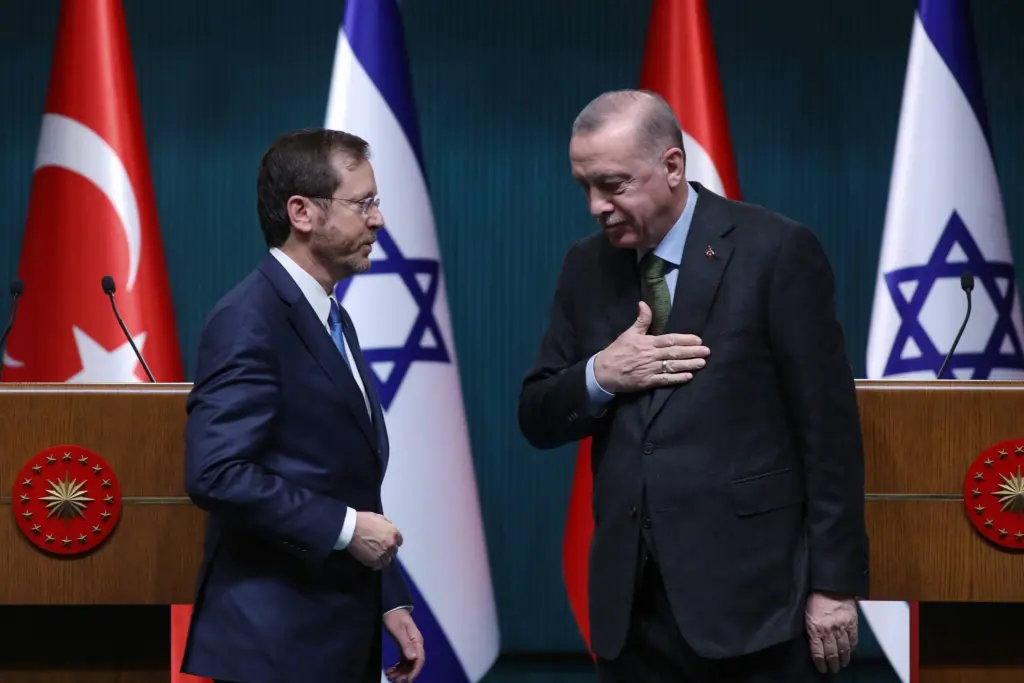
Despite Turkish President Recep Tayyip Erdogan’s loud denunciations of Israel following the war in Gaza, companies linked to his own family have continued to trade with Israel behind the scenes.
This investigative feature uncovers the commercial shipping links between Erdogan’s son and Israeli ports, the suppression of journalistic scrutiny, and the contradictions embedded in Turkey’s diplomatic posture during one of the Middle East’s most turbulent periods.
The Public Posture
Erdogan’s rhetoric during Israel’s assault on Gaza was unequivocal. He branded Israeli actions as genocide, halted arms exports, and in May 2024 officially suspended trade with Israel. In international forums, Turkey positioned itself as a defender of Palestinian rights. Yet, while Erdogan was calling for a boycott of Israel, vessels owned by his son’s companies were docking at Israeli ports.
The Family Connection
At the center of the scandal is Ahmet Burak Erdogan, the president’s eldest son, who co-owns MB Denizcilik, a shipping company founded in 2007. MB Denizcilik, alongside the closely linked Manta Denizcilik, operates a fleet of vessels that have carried goods to Israeli ports, even amid rising hostilities in Gaza.
One vessel, the Halit Yildirim, departed from Iskenderun, Turkey, on October 11, 2023—just days after the onset of Israel’s military campaign. It docked in Ashdod, Israel, on October 14, and later sailed to Florida. Public shipping records from MarineTraffic confirm this trajectory. This took place while Turkish media and the government were condemning Israeli military actions.
Business registries and Istanbul Chamber of Commerce filings reveal overlapping addresses, contact details, and ownership structures between MB Denizcilik and Manta Denizcilik. Journalists and shipping analysts have described these as possible shell-company arrangements to obfuscate political conflicts of interest.
Censorship and Legal Reprisal
Investigative journalist Metin Cihan, who first publicized these shipments, quickly became the target of a defamation lawsuit. In late 2023, the Erdogan family filed a criminal complaint accusing Cihan of “insult and defamation.”
Crucially, the legal complaint did not challenge the factual accuracy of the reported ship movements. Instead, it sought to suppress the story on reputational grounds. Turkish courts have since issued takedown orders for Cihan’s tweets, and a broader media blackout has followed. Other journalists, including Furkan Karabay, were sentenced to prison for covering similar allegations against former Prime Minister Binali Yildirim’s family.
As of June 2025, no court ruling has been issued that disproves or invalidates the trade allegations. The judicial process remains ongoing, heavily slanted toward silencing dissent rather than addressing the facts.
Trade Statistics Tell a Different Story
Even after Turkey’s formal suspension of trade with Israel in May 2024, trade volumes remained significant. According to UN Comtrade and Turkish Exporters’ Assembly data, Turkey exported roughly $2.86 billion in goods to Israel in 2024, making it one of Israel’s top five suppliers.
Meanwhile, exports to the Palestinian territories surged by over 400%. Analysts suspect that many of these goods were actually intended for Israel, re-labeled for Palestinian destinations and transshipped. This mirrors past practices where shipments are swapped mid-route or repackaged under alternative invoices—claims echoed by Cihan in his reporting.
What’s Missing—and What We Know
Direct access to shipping manifests, insurance records, and bills of lading remains restricted. These documents would conclusively prove cargo contents, delivery recipients, and final destinations. However, maritime tracking, court filings, and export patterns all reinforce the allegation that Erdogan-affiliated companies continued to profit from trade with Israel while publicly decrying Israeli policy.
No legal finding has disproved these facts. Instead, evidence points to calculated hypocrisy: public condemnation of Israel combined with covert commercial benefit.
The Cost of Hypocrisy
The Erdogan administration’s handling of Gaza has garnered widespread attention, both for its vocal opposition to Israel and for its role as a supposed leader of the Muslim world. But behind the scenes, a different story emerges—one of profit, concealment, and authoritarian suppression.
While journalists face jail for uncovering truths, and courtrooms are weaponized to silence dissent, the Erdogan family’s commercial interests appear untouched. This contradiction lies at the heart of Turkey’s modern foreign policy: nationalist populism for public consumption, and transactional pragmatism for private gain.
This is not merely a story of one family’s alleged profiteering. It is a window into how power, wealth, and propaganda intersect to obscure truth in the age of permanent crisis.
—
Erdoğan’s Fiercest Attacks on Israel
- “Israel is a war criminal state.”
Date: October 25, 2023
At a massive rally in Istanbul, Erdoğan declared:
“Israel is openly committing war crimes… I say it clearly: Israel is a war criminal state. We will not remain silent. We will never approve of this oppression.”
He added that the Israeli government was targeting civilians and hospitals, and warned the West: “You are literally aiding and abetting a massacre.”
- “Netanyahu is no different from Hitler.”
Date: November 2023
In remarks following Israeli attacks on Gaza, Erdoğan said:
“What Netanyahu is doing is no different from what Hitler did. His hands are soaked in the blood of innocent babies. Israel has lost all legitimacy.”
This statement made global headlines and led to a diplomatic freeze with Tel Aviv.
- “We will not allow trade with murderers.”
Date: May 2024
Announcing the suspension of trade with Israel, Erdoğan told parliament:
“Our ports will no longer serve as a gateway for goods to and from a state that bombs children and aid convoys. Let the world know—we will not allow trade with murderers.”
Despite this, UN trade data showed nearly $3 billion in Turkish exports to Israel that year—many via rerouted or mislabeled shipments.
—
Who Is Ahmet Burak Erdoğan?
Born: July 4, 1979, in Istanbul
Family: Eldest son of President Recep Tayyip Erdoğan and Emine Erdoğan; siblings include Bilal, Esra, and Sümeyye
Education: Graduated from Kartal Imam‑Hatip High School; earned a bachelor’s degree from Istanbul Bilgi University and studied economics in London on scholarship
Personal Life: Married Sema Ketenci in 2001; they have one child
Early Incident: In 1998, involved in a fatal traffic accident that resulted in death of singer Sevim Tanürek; fled scene without a license, later fined—widely reported as politically influenced
Career in Maritime Industry
Initial Venture: Co-founded Turkuaz/Bumerz Denizcilik in April 2006 with family members, including brother and brother-in-law; later pivoted to MB Denizcilik in 2007 with partner Mecit Çetinkaya
Expansion: By 2013, MB Denizcilik owned at least six ships—including Safran‑1 and Pretty—with capacities between 90,000–95,000 tons; valued at over $80 million
Operational Links: Partner company Manta Denizcilik shares ownership, offices, and management with MB Denizcilik, raising questions about shell entities and corporate opacity
Trade with Israel
Reports indicate ships such as Safran‑1 and Halit Yıldırım—associated with MB/Manta—sailed to Israeli ports during the Gaza conflict in October 2023, despite the government’s official boycott
Why It Matters
Burak Erdoğan’s prominent position within Turkey’s maritime sector—and the timing of his company’s port calls—underscore a stark contrast between public rhetoric and private commerce. His low profile, limited media presence, and discreet business structures further complicate efforts to trace transparency and accountability in his overseas dealings.